

This page contains affiliate links. Learn more.
Our Verdict (Best For)
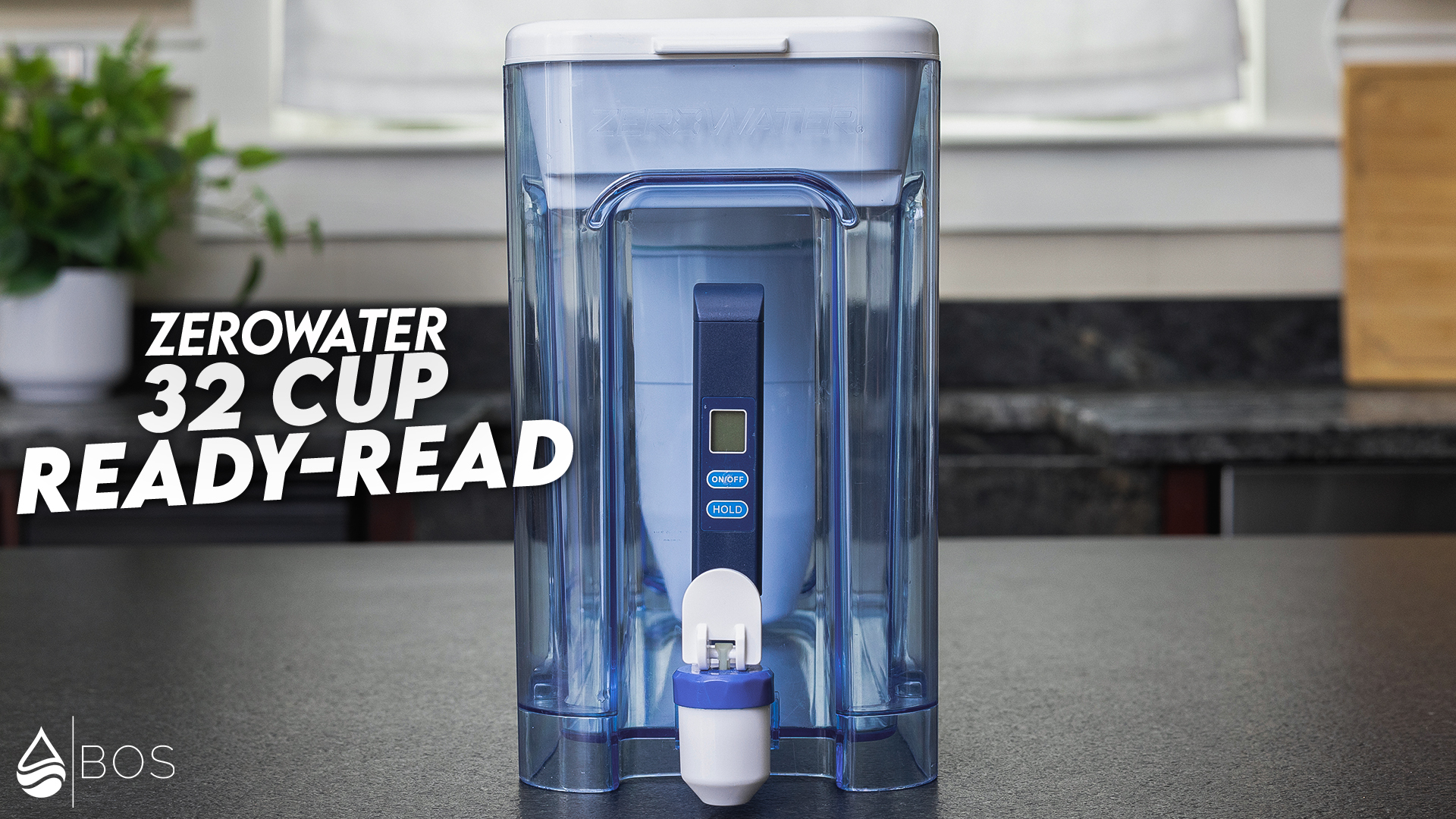
The ZeroWater 32 Cup produced excellent lab results and clean-tasting water, although it might not be the best for DBPs. It has a few key NSF/ANSI-certified contaminants + matching third-party testing but misses organics. Usability is so-so: setup and filter changes are easy (+ there’s a TDS meter, but we don’t like the 0 TDS approach). Filtration is pretty fast but not quite on-demand, processing the 7.5-cup feed tank in ~12:53 min. It dispenses 1 cup (no splashing) in a very fast ~4.25 sec but requires a counter/shelf edge or stand to pour. Plus, our unit stopped filtering at ~16 cups. Refilling is easy, but unfiltered water isn’t visible through the opaque feed tank. More pros: sturdy, slim build, fits fridge shelves. More cons: more daily refills, short 90-day warranty, short 15-gal filter life and thus very high ongoing filter costs. All in all, not one of our top countertop water filters.
The ZeroWater 32 Cup Ready-Read is a countertop water filter dispenser that doesn’t require a plumbing connection. It’s designed for use as a drinking water filter and can purify both tap water and properly disinfected well water (pre-treatment may be required).
As usual, we’ve tested the system with our own hands:
- Hands-on experience: We assembled, primed, used, and maintained it.
- Filtration effectiveness: We sent an unfiltered and a filtered tap water sample to a professional laboratory for analysis to determine real-world contaminant reduction. We also reviewed NSF/ANSI certifications and other available test data.
- More testing: We conducted taste and odor evaluations as well as filtration and dispensing speed tests.
- All other product aspects: We considered initial and long-term costs, warranties, additional features, frequent customer complaints, and more.

Final Rating: /5.00
FiltrationFiltration score combines our lab results and taste testing with NSF/ANSI certifications and 3rd-party contaminant reduction data.: /5.00
Usability: /5.00
CostsCost scores reflect overall value for money rather than price alone.: /5.00
| Type: | Countertop Water Filter Dispenser |
| PriceNo short-term sales. (Jul 13, 2026): | $44.99 |
| Yearly CostEstimate is based on rated/claimed filter life and 500 gallons annual water consumption. No short-term sales. (Jul 13, 2026): | ~$400 |
Final Rating: /5.00
What We Like Most
- Excellent results in our lab testing.
- Clean taste with no odor.
- Handful of important NSF/ANSI certifications for contaminant reduction + third-party testing of the same contaminants to 100% filter life (misses most organics).
- Sturdy, BPA-free, slim plastic build – fits tight spaces and fridge shelves.
- Easy setup with clear, illustrated instruction booklet.
- Suited for daily use.
- Very fast, splash-free dispensing with no leaking or dripping after spigot is closed.
- Can fill a 40-oz bottle with a single feed tank in one go.
- Easy to refill using sliding cover in lid.
- Easy filter changes – quickly twists in/out from bottom of reservoir.
What We Don’t Like
- Poor chloroform reduction (testing additional filter elements in the ZeroWater pitcher also demonstrated inconsistent DBP reduction).
- “0 TDS approach” can be misleading (0 TDS does not necessarily mean pure water).
- On-demand filtration requires a little patience.
- Stopped filtering once ~16 cups accumulated in clean tank.
- Above-average number of daily refills.
- Cannot fit a glass, 40-oz bottle or pitcher under the spigot – requires stand or shelf/counter edge for pouring.
- Cannot see unfiltered water through opaque feed tank.
- Very short 15-gallon filter lifespan requiring frequent replacements.
- No filter life indicator (though the included TDS meter helps track status).
- Substantially above-average ongoing filter replacement costs.
- Short 90-day system warranty.
- Customer complaints include very short filter life/filters too expensive, taste/odor issues (fishy, sour, lemony, metallic), and slow filtration/clogged filters.
How the ZeroWater 32 Cup Ready-Read Compares to…
25 Other Countertop Water Filters
In this video, Sara explains why the ZeroWater 32 Cup Ready-Read did not become one of our top picks among the 26 countertop water filters we tested.
Please note: Our full guide on the best countertop water filters is available here.
Video Chapters + Comparison Sheet
- Link to Comparison Sheet
- 00:00 – Intro
- 00:33 – Our 26 Countertop Filters
- 03:14 – How We Tested & Rated
- 09:11 – Best Overall (AquaTru Classic)
- 14:33 – Best RO Budget Pick (AquaTru Carafe)
- 16:50 – Honorable Mention (Bluevua RO100ROPOT)
- 18:27 – Best “Regular” Filters (Aquasana CWM & ZeroWater)
- 27:47 – Best “Regular” Budget Pick (Waterdrop ED04)
- 33:04 – Summary
Full Analysis of the ZeroWater 32 Cup Ready-Read
Filtration: /5.00
The ZeroWater 32 Cup Ready-Read scored 4.13/5.00 for filtration. How? Most importantly, it achieved excellent results in our 2024 lab testing, and the filtered water tasted and smelled perfectly clean. While the system has a handful of NSF/ANSI certifications for the reduction of a few important contaminants (plus third-party testing to 100% filter life for the same impurities), most organics are not covered.
1. Lab Results: /5.00

Remember that our before vs after lab comparison is not an exact science. It’s informational and subject to variability, inaccuracies, and interferences caused by natural fluctuations in water quality, accidental contamination, human error, instrumentation issues, and more. Furthermore, our lab testing is limited to those contaminants present in our water supplies and at their respective concentrations, which is why the results may contradict third-party test data. As such, our lab testing can only give us a general idea for how effective a certain water treatment product might be.
In our lab test comparing an unfiltered and a filtered tap water sample, the ZeroWater 32 Cup could remove 11 undesirable impurities and contaminants to below the minimum detection level (so essentially to 100%): chlorine, bromodichloromethane, dibromochloromethane, copper, barium, boron, zinc, lithium, strontium, nitrate, and uranium.
The following substances remained in our water (note: in our view, most concentration increases are generally due to leaching, although natural fluctuations cannot be ruled out):
- Chloroform increased by 95%. At 1.07 ppb, it was 2.68x higher than the strictest chloroform health guideline we could find (0.4 ppb, California OEHHA). Associated effects above that guideline include an increased risk of bladder cancer. That said, we suspect this increase may reflect natural variability in our water sample rather than potential leaching.
- Fluoride was reduced by a minimum of 75% and up to 99%.
Side note: We also tested three additional ZeroWater filter elements in the ZeroWater 10-Cup Ready-Pour Pitcher – one in 2024 and two in 2025 – which we discuss in more detail in our best water filter pitchers guide. For this testing in 2024, chloroform was not detected in our tap water, but all three disinfection byproducts (DBPs) that were present were completely removed. However, in our 2025 pitcher testing, we noted inconsistencies in DBP removal (including chloroform): this ranged from complete or nearly complete DBP removal (94-100%), even at extremely high feed water concentrations, to more modest removal (41-45%), even at much lower initial concentrations of the same contaminants. Collectively, these results suggest that ZeroWater filters may have difficulty consistently removing chloroform and other DBPs (or organic compounds in general).
Lab Results Chart
| Potentially Harmful | Aesthetic Issues | Feed Water Level | Filtered Water Level | Reduction Rate | |
| Water Disinfectants | |||||
| Chlorine (mg/L) | ✖ | ✖ | 0.82 | 0 | 100% |
| Disinfection Byproducts | |||||
| Bromodichloromethane (µg/L) | ✖ | 0.61 | 0 | 100% | |
| Dibromochloromethane (µg/L) | ✖ | 0.55 | 0 | 100% | |
| Chloroform (µg/L) | ✖ | 0.55 | 1.07 | 95% Increase | |
| Metals | |||||
| Copper (mg/L) | ✖ | ✖ | 0.06 | 0 | 100% |
| Barium (mg/L) | ✖ | 0.04 | 0 | 100% | |
| Boron (mg/L) | ✖ | 0.05 | 0 | 100% | |
| Zinc (mg/L) | ✖ | 0.01 | 0 | 100% | |
| Lithium (mg/L) | ✖ | 0.01 | 0 | 100% | |
| Strontium (mg/L) | ✖ | 0.44 | 0 | 100% | |
| Salts | |||||
| Nitrate (N) (mg/L) | ✖ | 1.42 | 0 | 100% | |
| Fluoride (mg/L) | ✖ | 0.4 | <0.1 | Anywhere between 75% and 99% | |
| Other | |||||
| Uranium (µg/L) | ✖ | 1 | 0 | 100% | |
| Other Parameters | |||||
| pH | 7.89 | 7.27 | |||
| Impurities NOT Detected in Unfiltered Tap Water Sample | |||||
| Lab Reports: Filtered Water Report, Unfiltered Water Report | |||||
| Explanation: | |||||
| Full Removal | |||||
| Considerable Reduction | |||||
| Concentration More than Double of Unfiltered Water Sample | |||||
| Potential Leaching Reached or Exceeded the Strictest Public Health Guideline We Could Find | |||||
2. NSF/ANSI Certifications and Other Test Data
The ZeroWater 32 Cup is certified for the reduction of 7 contaminants (including some important ones) by the IAPMO against NSF/ANSI standards 42 and 53. These certifications cover chlorine (99.40%), taste and odor, lead (98.80-98.90%), mercury (94.20-96.60%), PFOA/PFOS (99.80%), and hexavalent chromium (99.40-99.50%). Reduction rates are per the official performance data sheet.
In addition, the system has third-party testing for the removal of the same substances against NSF/ANSI standards 42 and 53 to 100% filter life. However, a number of contaminants, including most organics, are neither certified nor third-party tested.
3. Filtration Process
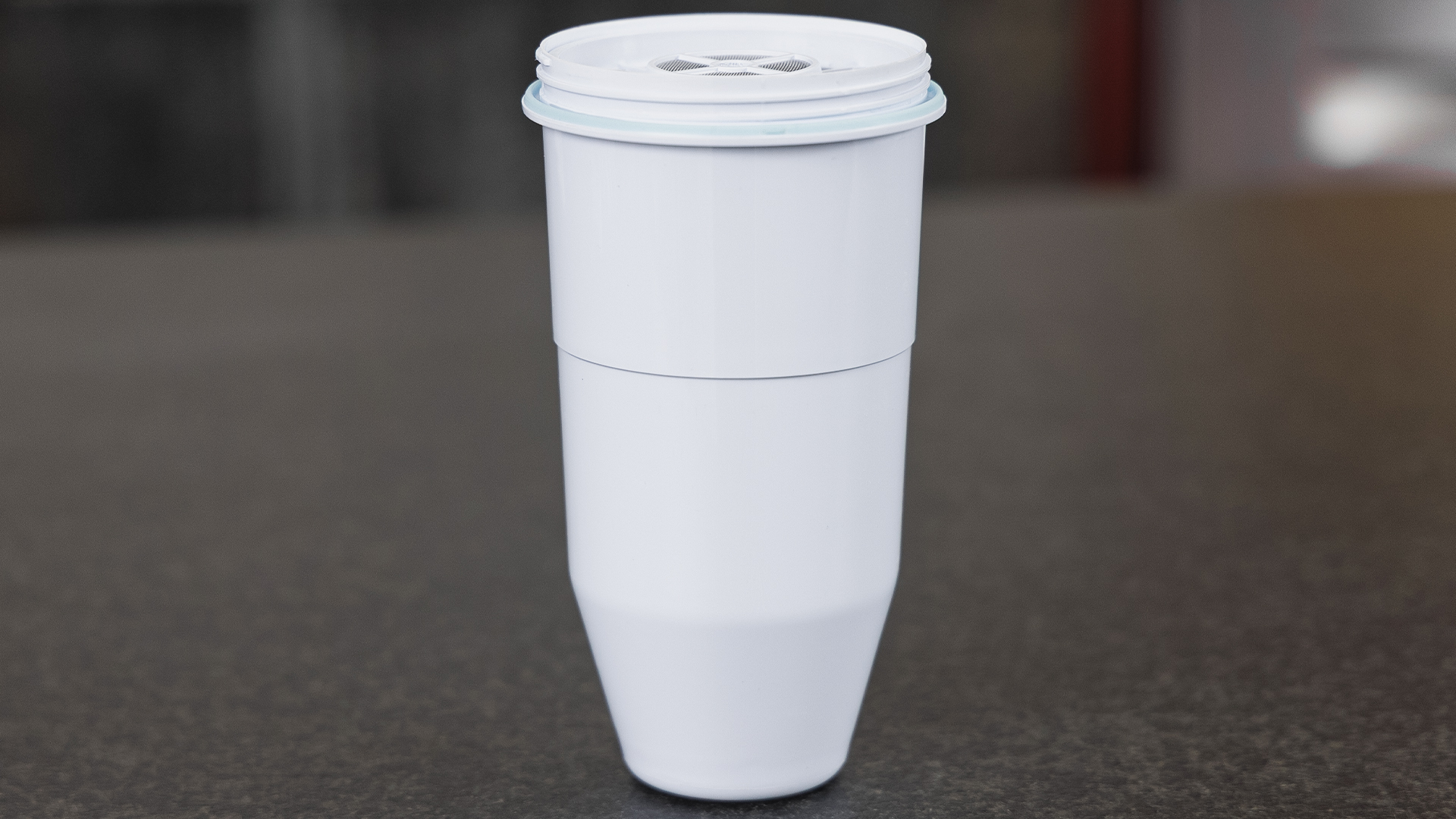
The ZeroWater filter cartridge utilizes particle filtration, activated carbon, KDF, and ion exchange resin.
- Particle filtration (mechanical filtration) is performed by mesh screens which trap solid, undissolved impurities like sand, rust, and dirt.
- Activated carbon removes things like bad tastes and odors, chlorine/chloramine, disinfection byproducts and other organics, as well as certain metals. This carbon is mixed with KDF media, a copper-zinc blend which also removes chlorine and certain water-soluble heavy metals (e.g., lead, mercury, and iron) while inhibiting microbial growth.
- A mixed bed of ion exchange resin targets dissolved, unwanted ions in the water – including metals and salts.
4. Taste and Odor Test
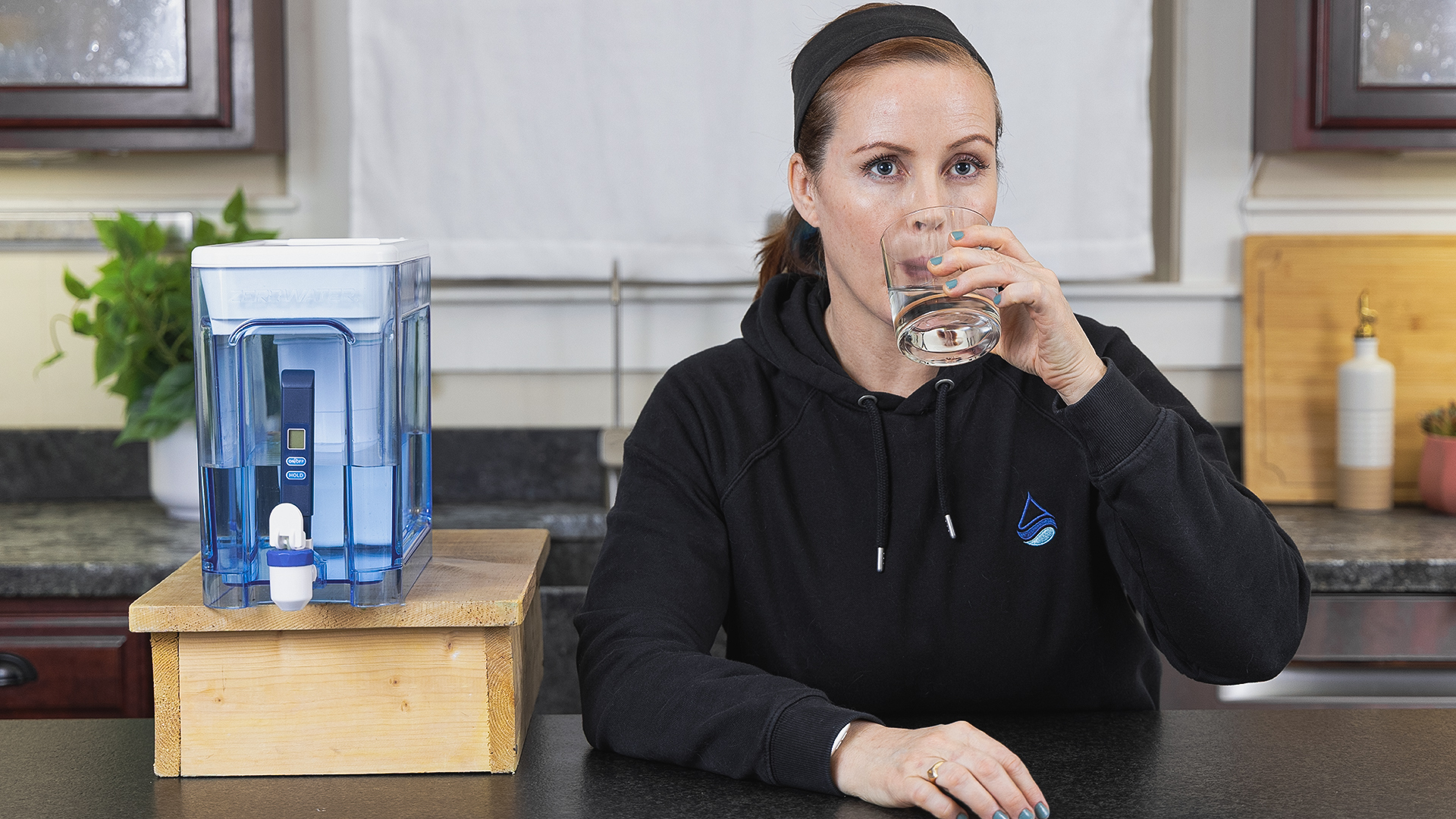
In our test, the filtered water was odorless and had a perfectly clean taste.
Usability: /5.00
The ZeroWater 32 Cup achieved a usability score of 3.38/5.00, based on its performance in the following categories:
- Initial system assembly including filter priming (1.00/1.00)
- Everyday use (1.88/3.10)
- Filter replacements (0.50/0.90)
1. Initial Setup & Filter Priming: /1.00
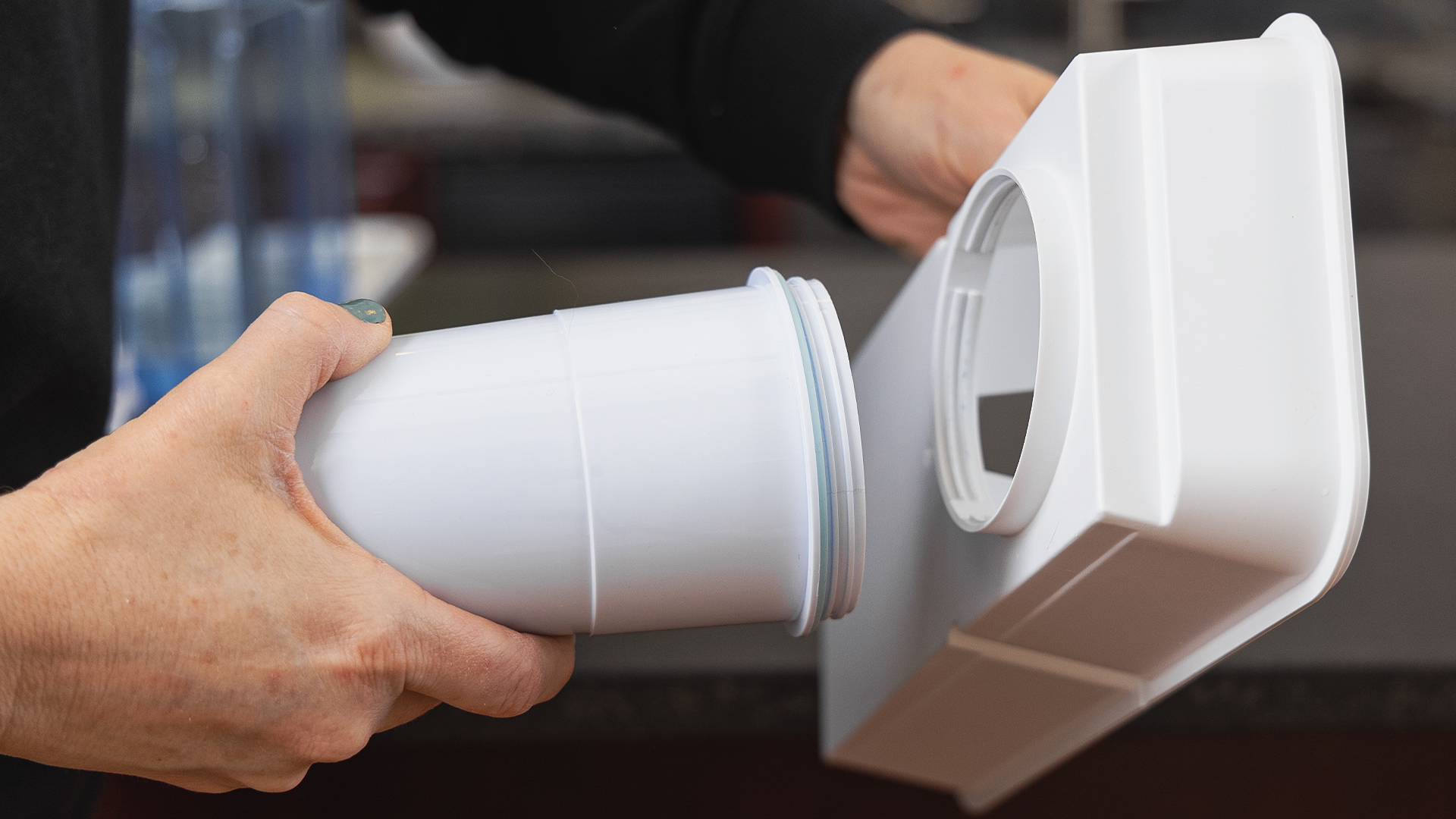
Assembling the ZeroWater 32 Cup is easy. The included instruction booklet provides clear, illustrated directions for each step.
Here’s a quick breakdown of the setup procedure:
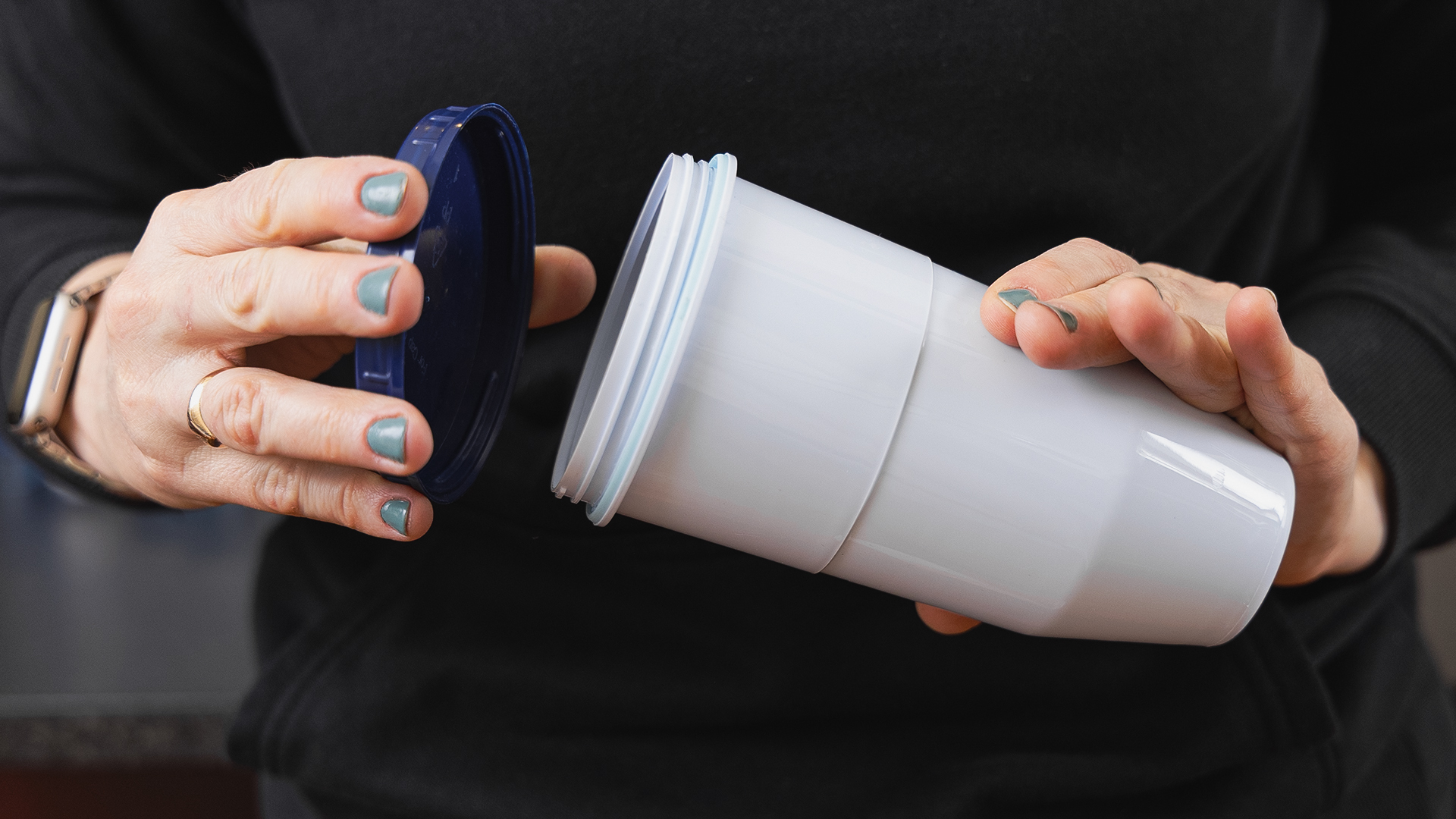
- Remove lid and reservoir from the dispenser. Remove film or blue cap from filter (if present).
- Clean the system using mild soap and warm water, then rinse and dry. Rinse the exterior of filter with warm water for 30 seconds.
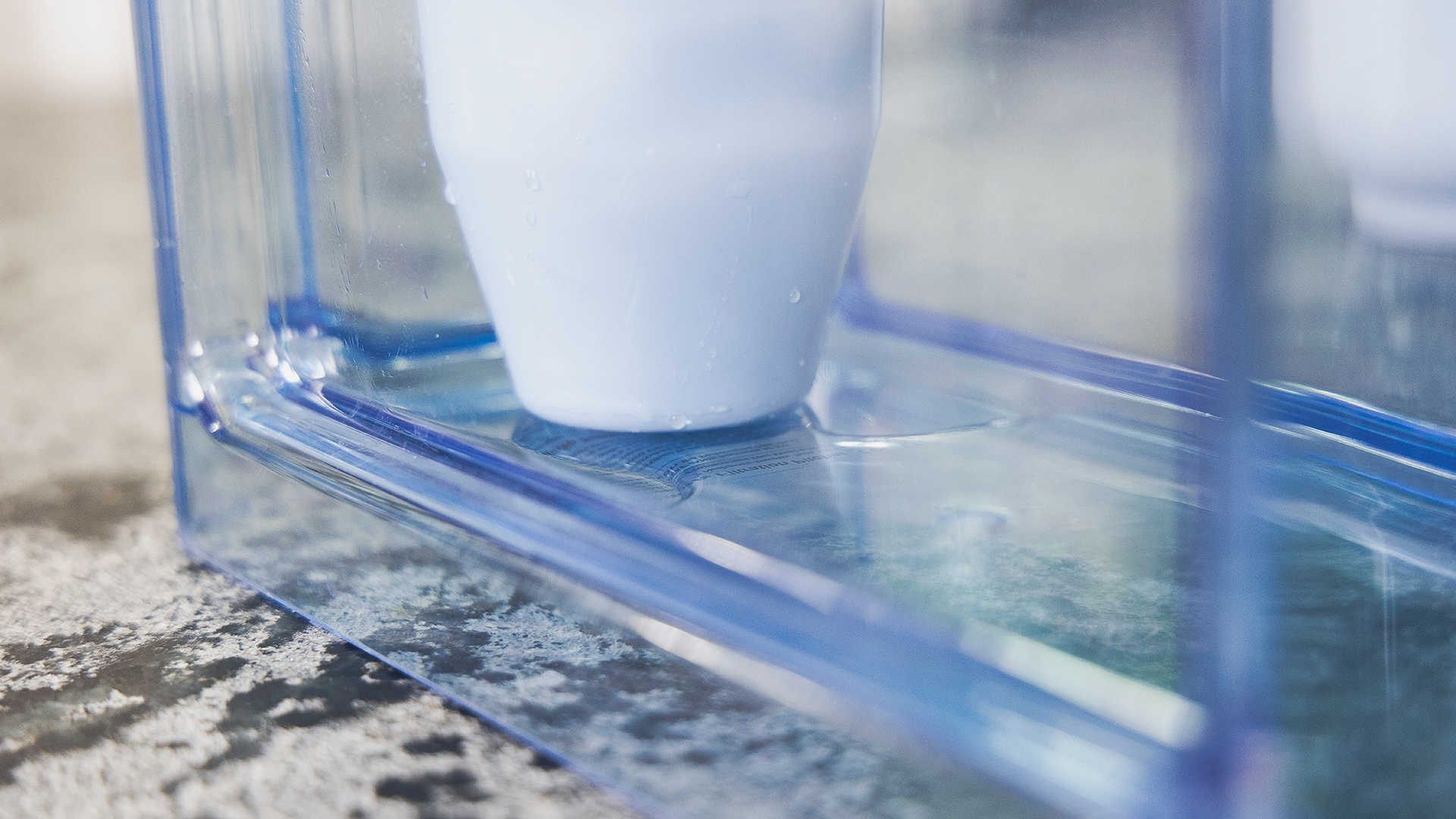
- Twist filter into the bottom of the reservoir, tightening until there is a complete seal between the filter, blue O-ring and reservoir.
- Align spigot with hole in clean tank, pushing in until you hear a click.
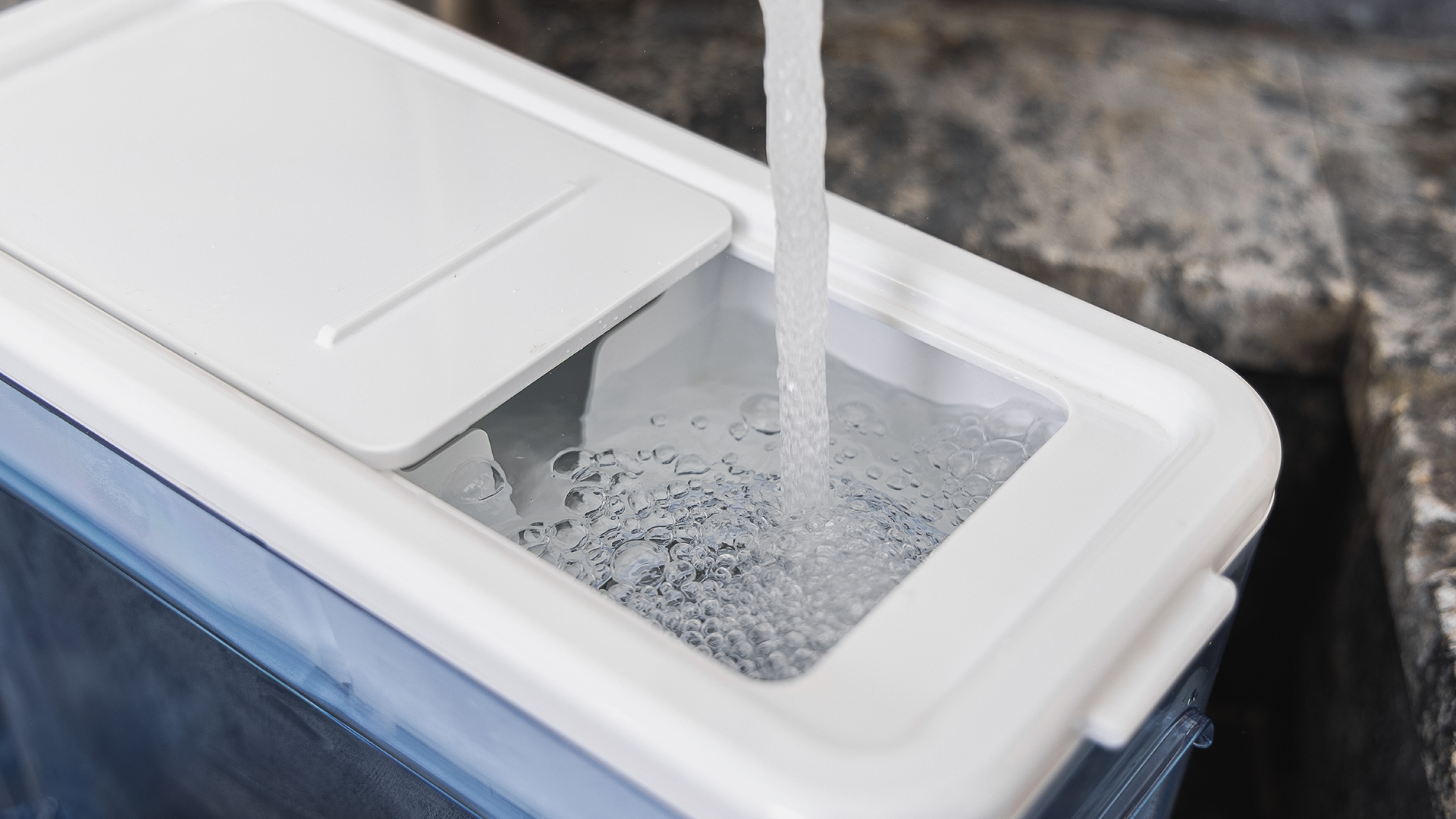
- Fill reservoir with cool or ambient water, directly onto the filter. Discard the first two reservoirs of water and replace the lid.
- Now your system is ready to use.
2. Day-to-Day Use: /3.10
2.1 Speed & Water Capacity: /1.20
The ZeroWater 32 Cup is suited for daily use but on-demand filtering, which we define as 1 cup in <1 minute, takes just a little more patience. The system filtered and dispensed 1 cup in ~1:10 min and 4 cups in ~6:13 min in our filtration speed tests.
However, as the spigot sits just above the bottom of the clean tank, the system must first process and collect ~2 oz of water before any can be dispensed, which took ~57.25 sec. As a result, starting from an empty system, the total time to filter and dispense 1 cup was ~2:07 min, while dispensing 4 cups took ~7:10 min.
Requiring only 12:53 min to fully filter and dispense the entire feed tank, the ZeroWater 32 Cup can produce large volumes relatively quickly for a dispenser-style system. It’s definitely fast enough to handle 8-10 cup/hour thirst bursts for average US households, which we assume consist of 2.55-3.15 people.
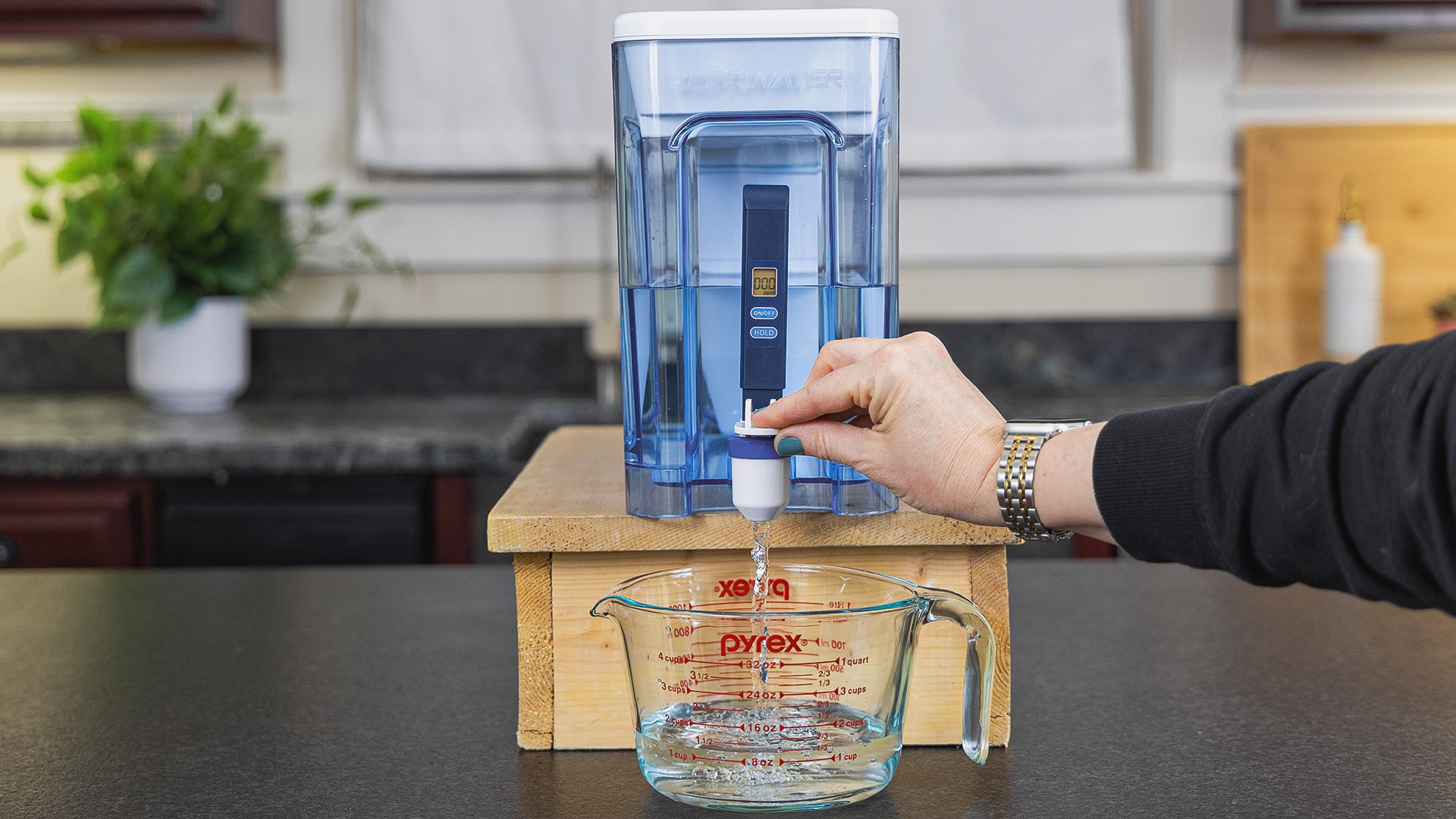
Dispensing filtered water from a full clean tank is also very fast – we measured about 4.25 seconds for 1 cup.
The 7.5-cup feed tank allows you to fill a 40-oz bottle from a single refill (but not a 2-quart pitcher). While the dispenser features a 24-cup clean tank, ours never filled up more than ~16.25 cups at the most before filtration would stop. A couple of factors may have been at play, such as air trapping within the filter or airlock between the feed and clean tanks.
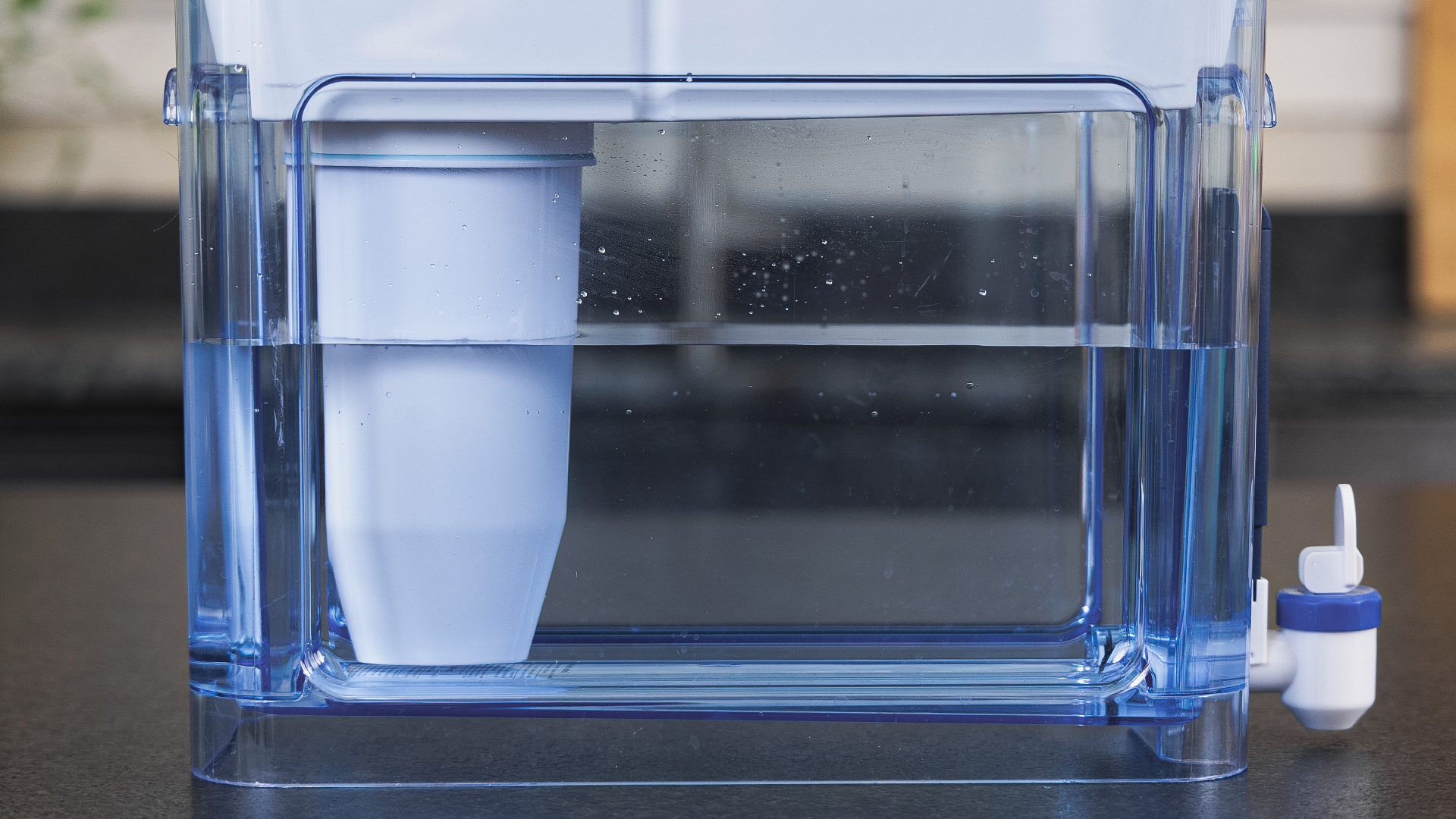
Assuming 25.5–31.5 cups of daily water consumption for the average US households, we estimate 4-5 daily refills when filling the system nearly to the top – above average for the countertop water filter dispensers we tested.
2.2 Dispensing: /1.00
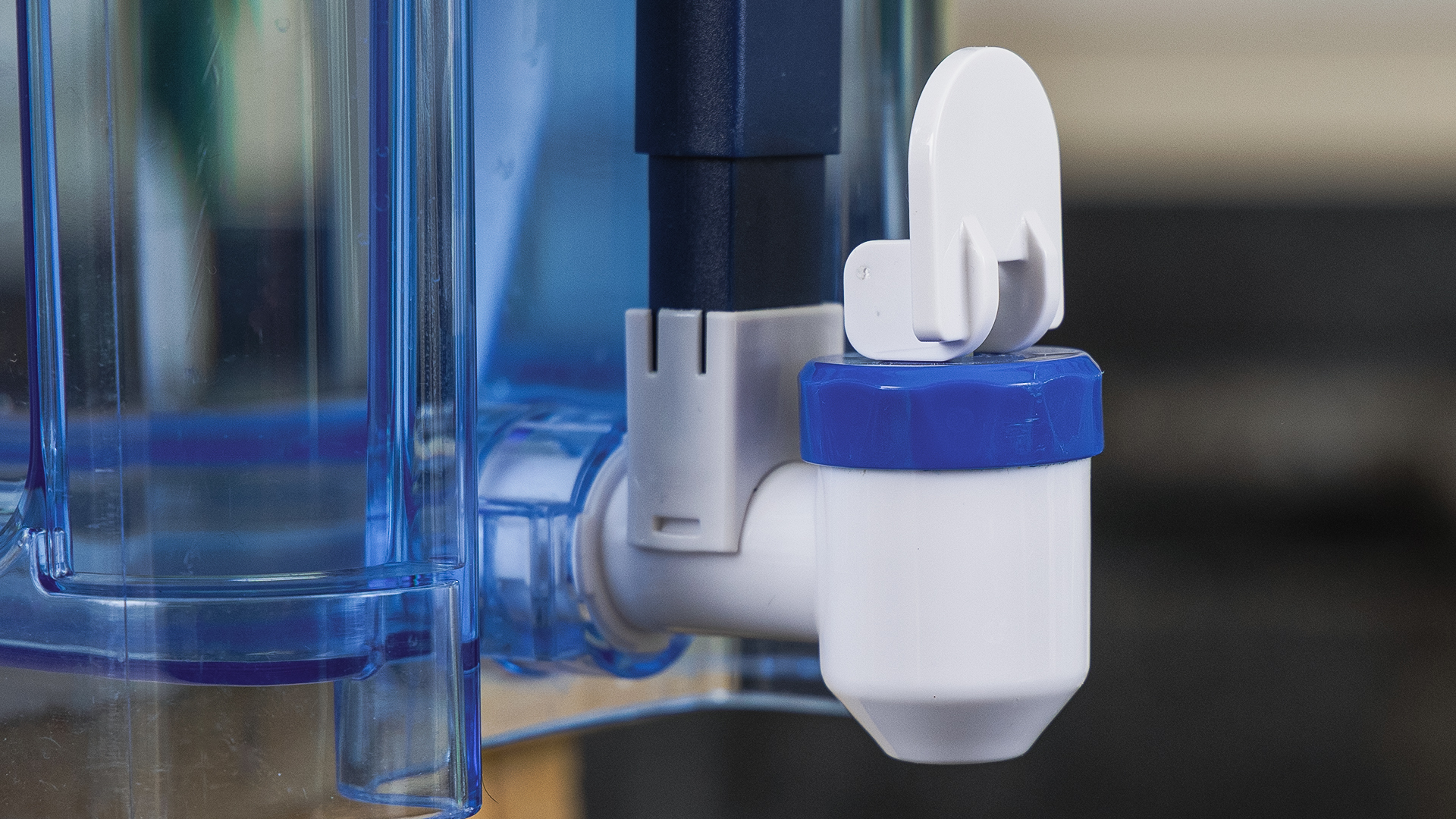
Using a full clean tank, dispensing water is very fast and without splashing. The sturdy plastic spigot is easy to use, and there is no dripping after the pour.
Due to the low spout height, the system must sit on a stand or at the edge of a counter or fridge shelf to allow enough clearance for pouring into glasses, 40-oz bottles, or pitchers.
Plus, since the spigot sits just above the base of the clean tank, the last ~2 oz of water cannot be poured unless you tilt or angle the tank forward. However, this is a common limitation and applies to all dispenser-type countertop filters we tested.
2.3 Refilling & Size: /0.90
Refilling the ZeroWater 32 Cup is easy thanks to the sliding cover in the lid. Simply use a pitcher or other container to fill the upper reservoir with water or place the unit in the sink and fill directly from the faucet. There is no max fill line, however, and the user manual does not specify a fill amount.
Unfortunately, the opaque upper reservoir does not allow you to see how much water remains to be filtered. You’ll have to open the lid to see if there’s room to top off and be careful when moving the unit after refilling to avoid spilling any unfiltered water.
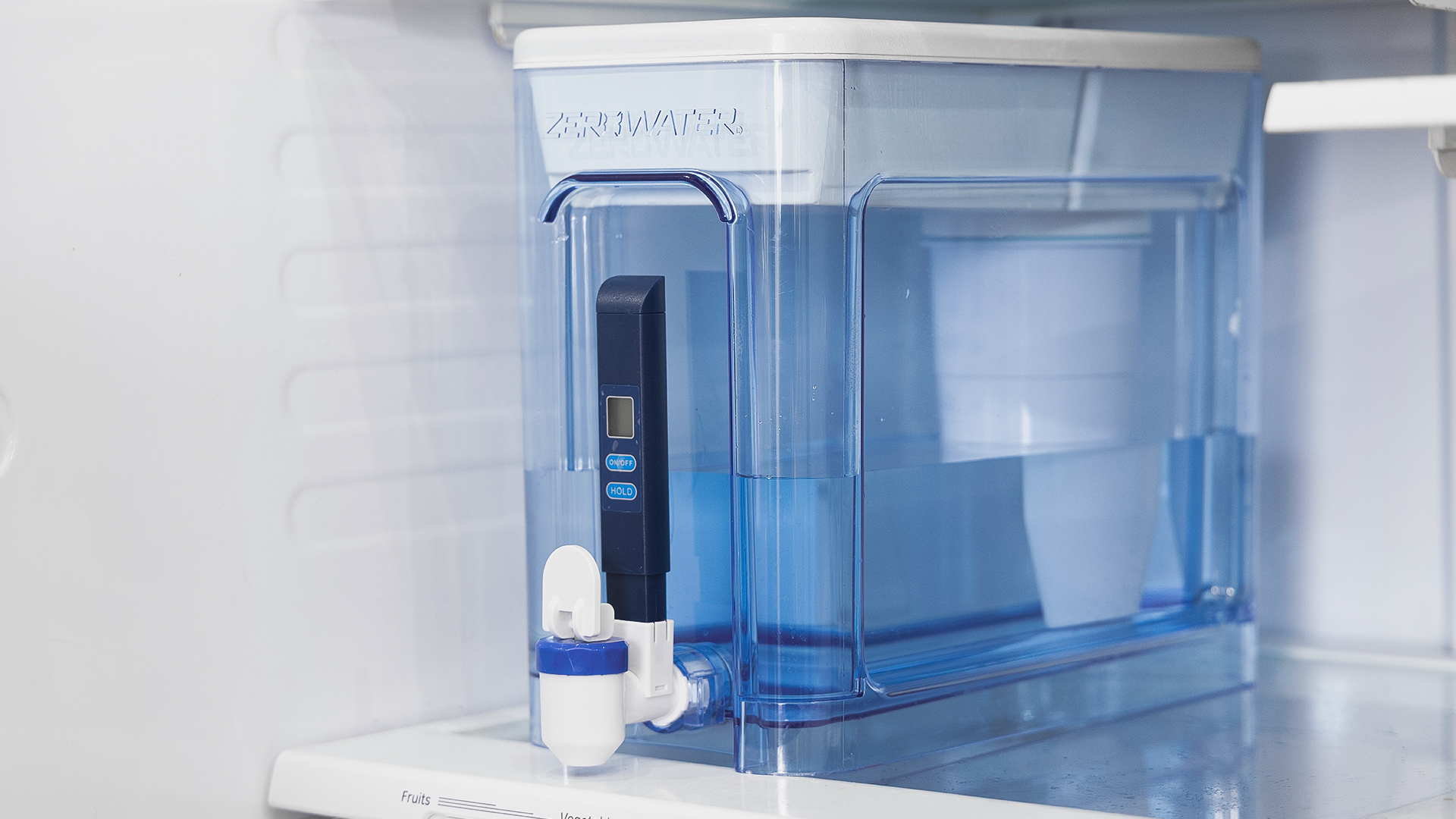
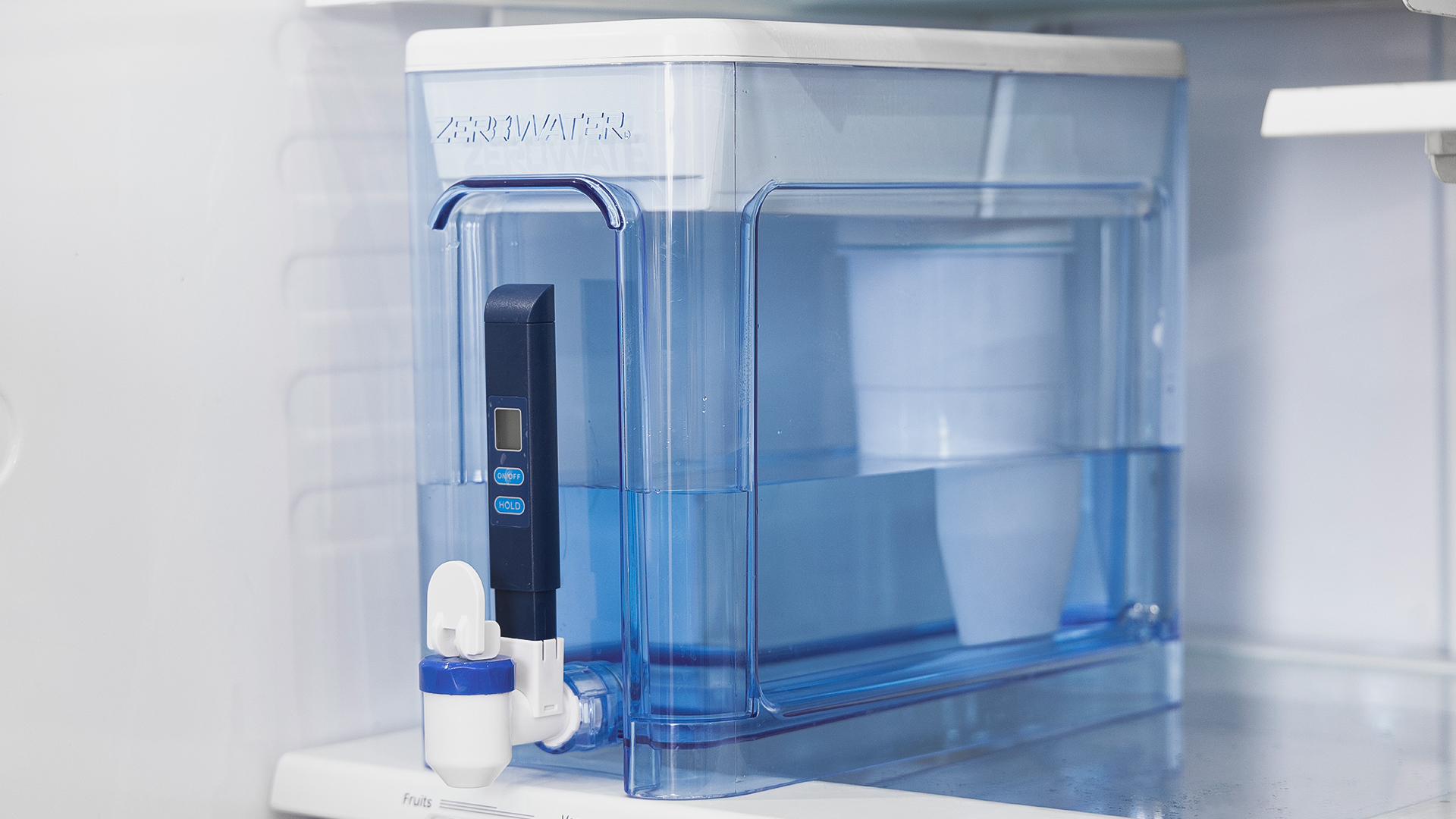
Measuring 6″x10.35″x14.4″ (WxHxD), the ZeroWater 32 Cup fits under most kitchen cabinets (18″ clearance). We could even place it on our fridge shelves without any rearrangement, though it’s too big for the door.
At 4.5 lbs with a wet filter installed, it’s relatively heavy for the dispenser-style countertop systems we tested. Its footprint is about average, occupying ~86.40 in2 (~0.60 ft2), but at less than 7″ wide, it’s streamlined enough to fit in narrow spots.
2.4 Other: /0.00
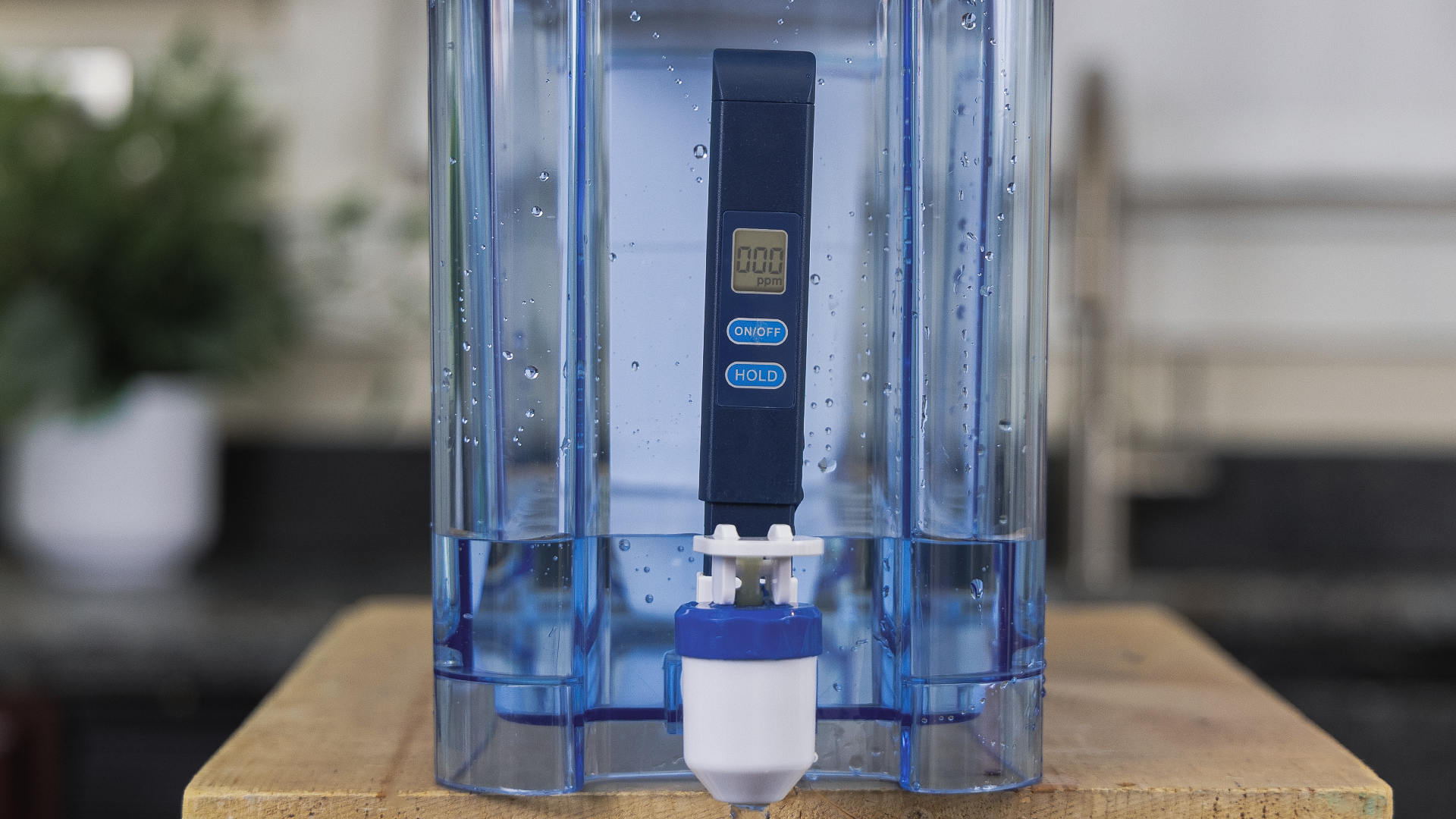
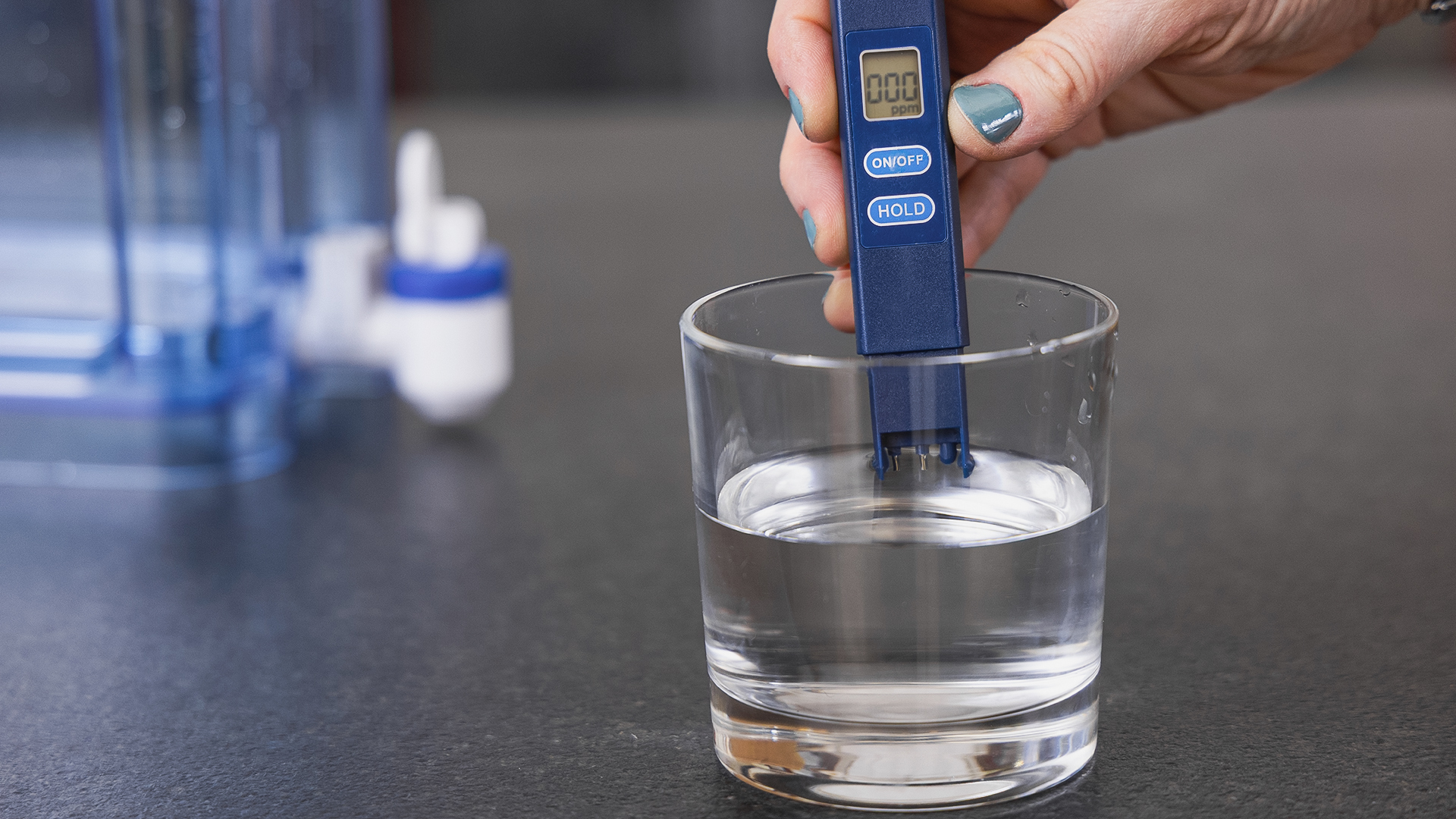
This system includes an accurate TDS meter which docks within the spigot for instant filtered water TDS readouts while dispensing. It’s also removable, so you can check the TDS of your tap water to gauge your starting point. However, we are not fans of the “zero TDS” idea.
- A TDS meter can’t detect several important impurities, including many organic compounds like disinfection byproducts, particulate lead, and other non-dissolved contaminants. Therefore, these substances don’t count towards total dissolved solids. What it does measure in tap water are mainly harmless or even beneficial salts and minerals.
- Additionally, a TDS meter reads in parts per million, so it’s far too imprecise for contaminants that can be harmful at much lower concentrations.
Since the information provided by the TDS meter can cause confusion and promote a false sense of security, we didn’t award the ZeroWater 32 Cup any extra points for this feature.
3. Filter Replacements: /0.90
Filter replacements are very simple: the filter is easily accessed from the underside of the reservoir and simply twists in/out to install.
While there is no filter change indicator to remind you, ZeroWater recommends that you replace your filter when the TDS meter reads “006” or higher. However, this approach means you may exceed its NSF/ANSI-rated filter capacity of 15 gallons.
Alternatively, based on this 15-gallon rated filter life and assuming 500 gallons of yearly water consumption for the average household, we estimate that you will have to change the filter every 1-2 weeks, which may get tiresome.
Support BOS Water’s Mission!
Every coffee helps us test more products and bring you unbiased results!
Costs: /5.00
Based on value for money, the ZeroWater 32 Cup achieved a cost score of 0.00 out of 5.00, indicating it is priced above average for what it offers compared to competing systems (a score of 4.00 represents average value). Notably, its upfront price is around average, but its annual filter replacement costs are substantially above average compared to the other countertop water filters we tested.
1. Upfront Price
As of Jul 13, 2026, the ZeroWater 32 Cup is priced at $44.99, which is around the $48.53 average we estimate for this type of water filter.
2. Long-Term Expenses for Filter Replacements
Based on 500 gallons consumption and a 15-gal filter life for the filter cartridge, we estimate $400 in annual filter replacement costs, which is substantially above the $120.11 average across all the tested countertop water filters.
3. Product Warranty
The ZeroWater 32 Cup warranty is rather short, covering the dispenser (90 days) and filters (30 days).
4. Other Cost Factors
- The built-in, removable TDS meter docks within the spigot to give real-time filtered water TDS readings.
- The system feels sturdy.
- ZeroWater offers a filter recycling program. While they don’t offer prepaid shipping and you don’t get a free filter, the manufacturer does provide a $20 coupon to help cover the cost of shipping upon receipt of the filters.
Additional
1. Construction
The unit is made from BPA-free plastic, and it feels sturdy and well-built overall.
2. Size Options
ZeroWater Ready-Read dispensers come in 2 different sizes: 22- and 32-cup.
3. Frequent Customer Complaints
We read about issues with the filtered water taste and odor (ranging from fishy, sour, lemony or metallic), slow filtration or clogged filters, and frustrations relating to the very short filter life (i.e., filters are too expensive).
Like some of the other customers, we found the frequent filter changes to be slightly laborious and extremely costly. We also detected a faint plastic taste in our 2025 testing of this filter in the ZeroWater 10-Cup Ready-Pour pitcher. While we did not find that the ZeroWater filtered particularly slowly, our system would not filter more than ~16.25 cups of water into the clean tank (despite its 24-cup rated capacity).
Bottom Line: Excellent Contaminant Reduction but Very Expensive Long Term (/5.00)
Filtration weighted at 60%, and usability and cost at 20% each, the ZeroWater 32 Cup scored a final rating of 3.15 out of 5.00.
Filtration performance was solid, with excellent lab results: the system completely removed 11 out of 13 contaminants in our lab test and produced filtered water that tasted and smelled perfectly clean. However, it only has 7 NSF/ANSI certifications for contaminant reduction (with third-party testing to 100% filter life for the same impurities); this covers a few key substances but misses most organics.
Plus, we have reservations about its ability to consistently remove DBPs (and maybe organics in general), based on this round of lab testing and our testing of three additional filters in the ZeroWater pitcher.
Usability is mediocre: it’s very easy to set up, and it processes water quickly enough for most households, though it’s not quite on-demand capable.
Due to its relatively small 7.5-cup feed tank, the system requires more daily refills than the average countertop water filter dispenser. Plus, our unit’s inability to filter more than 16.25 cups at one time (possibly due to an airlocked filter) effectively renders the clean tank capacity much less than the advertised 24 cups.
Dispensing is very fast as well as drip- and splash-free at 4.25 seconds per cup with a full clean tank. However, you either need to place the unit at the edge of your counter/fridge shelf or on a stand to pour, as the spout is located at the bottom of the dispenser.
The sliding lid cover makes refilling simple, but the opaque plastic hides the water level in the reservoir – you must open the lid to check it.
Filter replacements are also very easy, though there’s no filter change indicator light. Instead, the ZeroWater comes with a built-in TDS meter, but we are not fans of relying on TDS measurements to inform about water quality. And if following ZeroWater’s recommendations for filter changes when the meter reads 006, you may exceed its rated filter life.
The BPA-free plastic construction feels sturdy, though it’s a touch on the heavy side. Despite average overall dimensions, its narrow width allows it to slot into tight spaces – even on fridge shelves.
While its upfront price is about average, ongoing filter replacement costs are substantially above average due to their very short 15-gal rated lifespan. Warranty? No more than 90 days.
Overall, it features the best filtration performance out of the regular countertop systems we tested, but the ZeroWater 32 Cup doesn’t make the grade for a top-tier countertop water filter due to its prohibitively high long-term costs.
Further Reading
About the Author(s)

Sara has been a lifelong home-improvement fan (she’s been hooked on This Old House since she was five) and taught herself any project she didn’t already know by watching YouTube tutorials. She is also an award-winning filmmaker. Armed with this skillset, Sara installs, primes, samples, uses, and maintains nearly every point-of-use water treatment system we test – then brings her results to life on camera for our YouTube channel.

Raoul has a background in mechanical engineering and has been writing about home water treatment since 2015. He designs our product review processes, analyzes the results, and ties everything together. As editor-in-chief, he tries hard to keep the whole operation running smoothly behind the scenes.