

This page contains affiliate links. Learn more.
Our Verdict (Best For)
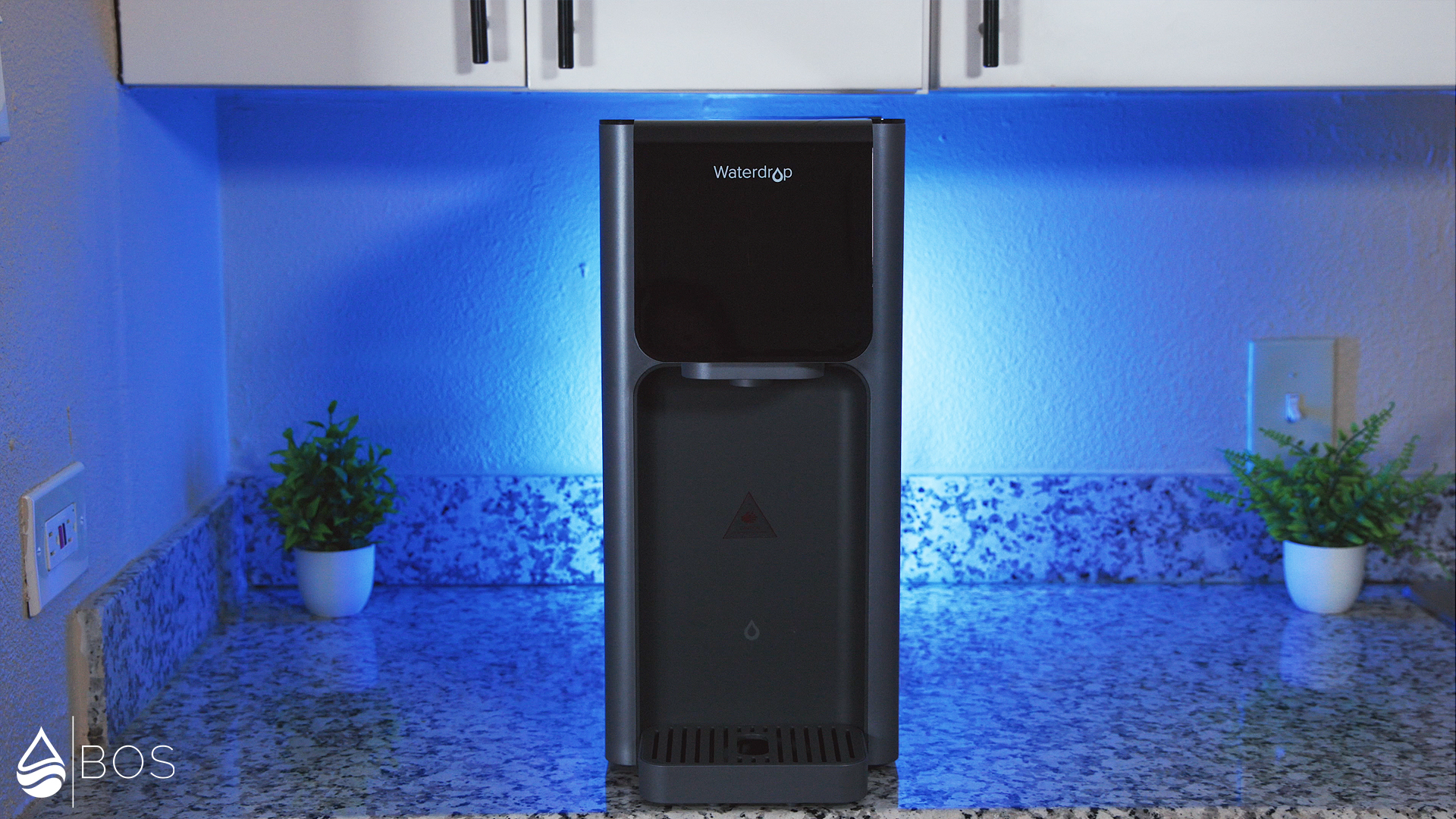
The newly updated Waterdrop A1 is a sturdy, well-built system that’s easy to set up and use, with very low wastewater. It earns our recommendation for the #1 countertop RO for those who want hot and cold water on demand (although the hot water could be a little hotter). The system offers a large and responsive touch screen with plenty of features (e.g. 6 water temp, 4 volume presets, TDS monitor, night & vacation modes). In our testing, the Waterdrop A1 removed almost all contaminants to below detection levels, and it had the highest TDS removal of all the RO systems we tested. Our filtered water also tasted and smelled great. Cons: Contaminant reduction testing against NSF standards? Yes, but no actual certifications. Also, the unit is tall and heavy, taking up lots of counter space, and it’s noisy, especially in cooling mode.
2025 Waterdrop A1 Update
When we first reviewed the Waterdrop A1, our lab testing detected an alarming amount of methylene chloride (11.87 ppb) in our filtered water, more than twice the OEHHA’s 4 ppb health goal for drinking water set to prevent liver problems and carcinogenic effects, and also more than twice the EPA’s 5 ppb legal limit for tap water. We also detected 0.71 ppb of xylene in our water, but at least that was well below health guidelines and legal limits. Still, we immediately stopped our testing and pointed out the potential leaching to Waterdrop back in 2024. To their credit, they subsequently pulled the system from the shelves to do an investigation and a redesign. The newly redesigned Waterdrop A1 is now available, and we recently conducted lab tests on this new version.
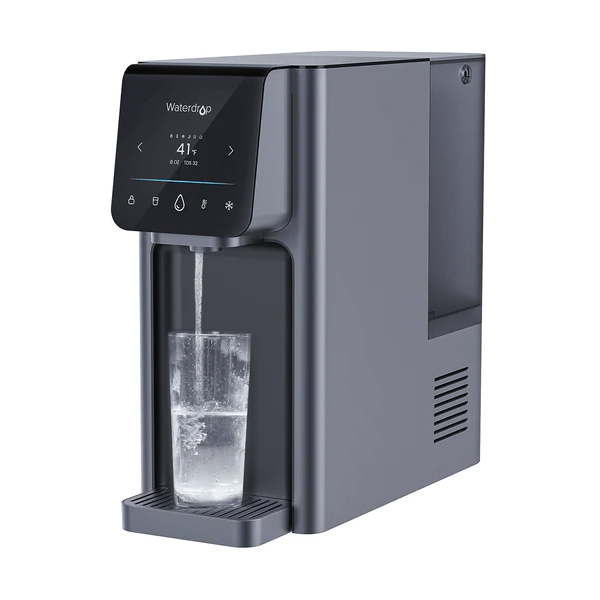
The Waterdrop A1 is a countertop reverse osmosis system that can provide both hot and cold water and that doesn’t require a plumbing connection. It’s designed for use as a drinking water filter and can purify both tap water and properly disinfected well water (pre-treatment may be required).
As usual, we’ve tested the system with our own hands:
- Hands-on experience: We installed/assembled, used, and maintained it.
- Filtration effectiveness: We sent an unfiltered and a filtered tap water sample to a professional lab for analysis in order to determine real-life contaminant reduction capabilities. Plus, we checked for NSF certifications and other test data.
- More testing: We performed a taste & odor test, a filtration speed test, water temperature tests, and a wastewater test.
- All other product aspects: We considered initial + long-term cost, product warranties, additional features, frequent customer complaints, etc.
Contents
Final Rating: /5.00
FiltrationFiltration score combines our lab results and taste testing with NSF/ANSI certifications and 3rd-party contaminant reduction data.: /5.00
Usability: /5.00
CostsCost scores reflect overall value for money rather than price alone.: /5.00
| Type: | Countertop Reverse Osmosis System With Hot & Cold Water |
| PriceNo short-term sales. (Mar 4, 2025): | $649 (Use Code A1BOS for 3% Off on Top of Most Waterdrop Sales!) |
| Yearly CostEstimate is based on rated/claimed filter life and 500 gallons annual water consumption. No short-term sales. (Aug 5, 2024): | ~$130 (Save 5% With Filter Subscription) |
(Use Code A1BOS for 3% Off on Top of Most Waterdrop Sales!)
Final Rating: /5.00
What We Like Most
- Achieved excellent results in our lab testing for contaminant reduction.
- Highest TDS removal rate of all RO systems we tested.
- Our filtered water was taste and odor-free.
- Pretty much fully covered by third-party NSF testing for contaminant reduction.
- Sturdy and well built, easy to set up with clear instructions and a video, and easy to prime and use.
- Produces hot and cold RO water on demand.
- Dispenses ambient water relatively fast but still requires patience.
- Large and responsive touchscreen with multiple temperature selections, water volume options, TDS monitoring, night & vacation modes, QR codes to access manual and service, and more.
- Easy filter replacements also thanks to filter life indicator, with a QR code for easy reordering.
- Additional features: Optional child safety for hot water, cooling can be turned off to save energy and reduce noise, boiling point correction, dispensing light, water change and shortage reminders.
- Very low wastewater.
- Average upfront cost for its class and below-average annual maintenance fees.
What We Don’t Like
- No actual NSF certifications for contaminant reduction.
- Tall, deep, and heavy; takes up a lot of counter space and may be hard to access the water feed tank.
- Hot water could be a little hotter.
- Noisy (especially the cooling mode).
- Night mode requires you to program a start and end time.
- 3rd-party customer complaints about malfunctioning units, leaking, unresponsive displays, hot not being hot and cold not cold, but these may have been addressed with the updated system.
Video: Sara Reviews the Waterdrop A1
Video Chapters
- 00:00 – Intro
- 00:35 – What Happened So Far
- 02:27 – The New Waterdrop A1
- 02:59 – Does It Still Leach?
- 03:28 – Contaminant Reduction
- 04:22 – Updated Google Sheet
- 04:47 – NSF Standards
- 05:17 – Taste & Odor
- 05:22 – Filter Process
- 06:05 – Usability
- 10:09 – Wastewater
- 10:23 – User Complaints
- 10:52 – Costs
- 11:24 – Summary
- 12:30 – Outro
How the Waterdrop A1 Compares to…
25 Other Countertop Water Filters
In this video, Sara covers our top picks among the 26 countertop water filters we’ve tested. The updated Waterdrop A1 model wasn’t included because too new. Still, it’s part of our countertop water filter comparison sheet.
Video Chapters + Comparison Sheet
- Link to Comparison Sheet
- 00:00 – Intro
- 00:33 – Our 26 Countertop Filters
- 03:14 – How We Tested & Rated
- 09:11 – Best Overall (AquaTru Classic)
- 14:33 – Best RO Budget Pick (AquaTru Carafe)
- 16:50 – Honorable Mention (Bluevua RO100ROPOT)
- 18:27 – Best “Regular” Filters (Aquasana CWM & ZeroWater)
- 27:47 – Best “Regular” Budget Pick (Waterdrop ED04)
- 33:04 – Summary
17 Other Countertop Reverse Osmosis Systems
In this video, Sara highlights our countertop RO top picks. The Waterdrop A1 became our #1 system for hot & cold water.
Please note: Our full guide on the best countertop RO systems is available here.
Video Chapters + Comparison Sheet
- Link to Comparison Sheet
- 00:00 – Intro
- 00:49 – What’s New
- 01:40 – Our 18 RO Systems
- 04:47 – AquaTru Classic (Pt. 1) + How We Tested
- 13:06 – AquaTru Classic (Pt. 2) + 3 System Types
- 18:05 – AquaTru Classic (Pt. 3)
- 26:19 – AquaTru Carafe + Bluevua ROPOT
- 39:34 – Hot Water: Waterdrop C1H
- 46:16 – Hot & Cold Water: Waterdrop A1
- 53:16 – Remaining Systems (Quick-Fire Round)
- 59:09 – Summary
Full Analysis of the Waterdrop A1
Filtration: /5.00
1. Lab Results: /5.00

Remember that our before vs after lab comparison is not an exact science. It’s informational and subject to variability, inaccuracies, and interferences caused by natural fluctuations in water quality, accidental contamination, human error, instrumentation issues, and more. Furthermore, our lab-testing is limited to those contaminants present in our water supplies and at their respective concentrations. As such, it can only give us a general idea for how effective a certain water treatment product might be.
Lab Results Chart
| Potentially Harmful | Aesthetic Issues | Feed Water Level | Filtered Water Level | Reduction Rate | |
| Water Disinfectants | |||||
| Chlorine (mg/L) | ✖ | ✖ | 0.98 | 0 | 100% |
| Disinfection Byproducts | |||||
| Bromodichloromethane (µg/L) | ✖ | 4.64 | 0 | 100% | |
| Bromoform (µg/L) | ✖ | 4.32 | 0 | 100% | |
| Dibromochloromethane (µg/L) | ✖ | 7.94 | 0 | 100% | |
| Chloroform (µg/L) | ✖ | 1.61 | 0 | 100% | |
| Metals | |||||
| Copper (mg/L) | ✖ | ✖ | 0.11 | 0 | 100% |
| Iron (mg/L) | ✖ | 0.02 | 0 | 100% | |
| Barium (mg/L) | ✖ | 0.04 | 0 | 100% | |
| Boron (mg/L) | ✖ | 0.06 | 0.03 | 50% | |
| Zinc (mg/L) | ✖ | 0.01 | 0 | 100% | |
| Strontium (mg/L) | ✖ | 0.40 | 0 | 100% | |
| Salts | |||||
| Nitrate (N) (mg/L) | ✖ | 1.93 | 0 | 100% | |
| Fluoride (mg/L) | ✖ | 0.69 | <0.1 | Anywhere Between 86% and 99% | |
| Other | |||||
| Uranium (µg/L) | ✖ | 1 | 0 | 100% | |
| RO Salt Rejection | |||||
| TDS (mg/L) | ✖ | 329.4 | 6.6 | 98% | |
| Impurities NOT Detected in Unfiltered Tap Water Sample | |||||
| m+p Xylenes (µg/L) | ✖ | 0 | 1.32 | ||
| Explanation: | |||||
| Full Removal | |||||
| Considerable Reduction | |||||
| Concentration More Than Double of Unfiltered Water Sample | |||||
| Potential Leaching Reached or Exceeded the Strictest Public Health Guideline We Could Find | |||||
*100% means reduction to below the minimum detection level. To learn more about our testing procedures check our editorial guidelines.
Link to Filtered Water Report
Link to Unfiltered Water Report
Usability: /5.00
Costs: /5.00
Please note: This page is still a work in progress. Additional content and details will be added shortly – stay tuned!
Paraphrased Video Script
When we first lab-tested the Waterdrop A1, methylene chloride – a chemical linked to cancer and liver problems – had leached into our filtered water at more than twice the EPA’s legal limit. As a result of our video, Waterdrop pulled the product to investigate the issue. Eventually, they released an updated version claiming the leaching had been resolved. We promised we’d do a re-test – and recently we did. So, let’s find out if the Waterdrop A1 Reverse Osmosis Hot & Cold Water Dispenser is finally safe to use…
Hey, Sara here with BOS Water and hopefully our final Waterdrop A1 video, most importantly featuring a lab test of the updated version to find out if it still leaches harmful chemicals. But before we get into that, let’s quickly recap what’s happened so far:
We had initially planned to review the first version of the Waterdrop A1 – which is a countertop RO system with integrated heating and cooling – in full as we usually do, meaning lab testing, speed test, wastewater test, overall usability, and so on. However, when our lab reports came back, they showed elevated levels of methylene chloride (also known as dichloromethane) and xylenes for the filtered water, whereas neither chemical had been found in our raw tap water, which suggested a serious leaching issue. Specifically, methylene chloride had been detected at 11.87 parts per billion, so far more than the strictest health guideline we could find set at 4 parts per billion, and also more than twice the EPA’s legal limit for public water supplies of 5 parts per billion.
Now, methylene chloride in drinking water has been linked to liver problems and an increased risk of getting cancer – in fact, this is why the EPA has started regulating the organic compound – so needless to say, we found these results pretty alarming. Which is why we conducted another round of testing to rule out any potential errors and the second lab report also listed methylene chloride, though at a slightly lower concentration. And then we found out that Derek from Modern Castle here on YouTube had also done a lab analysis of the Waterdrop A1, and he had also found methylene chloride in his water.
So after our video highlighting these concerns went live, Waterdrop decided to withdraw the A1 from all sales channels to conduct their own testing, which they did – they even tested the very same unit we used which we had returned to them. And essentially, the company confirmed the chemical leaching albeit at a much lower concentration. Several months later, Waterdrop re-released an updated version of the A1, stating the leaching issue had been resolved.
And that’s where we are right now – we got our hands on the new and hopefully improved A1, we set it up according to the manual, and we conducted our usual lab testing for real-life contaminant reduction capabilities and potential leaching, meaning we took an unfiltered and a filtered water sample, sent both to a professional lab for analysis, and compared the concentrations of all the different impurities and contaminants in our tap water before and after filtration. Wanna check out the results? Well, here they are!
Lab Test Results
First of all, we didn’t find ANY methylene chloride in our filtered water, and only a very tiny amount of xylenes at 1.32 parts per billion, so similar to what we found in our initial test, which is still not ideal, but when you consider that the strictest xylene health guideline we could find is at 500 ppb, so 378 times higher, we’re not really worried. So based on that, it indeed looks like there’s no more harmful leaching going on!
How about contaminant reduction, though? Well, keeping in mind that before-and-after lab testing isn’t an exact science, and that we can only test for the contaminants as they occur in our water supply, the new Waterdrop A1 did great! Everything removed to 100%, except boron 50% and small traces of fluoride remaining in our filtered water but at levels so low the lab couldn’t even quantify them, which makes the new Waterdrop A1 at least as effective at reducing fluoride as any of the 20 other RO systems we’ve tested up to this point. Also, 98% TDS reduction is the highest rate we’ve measured with any RO so far – so this looks really promising!
Bottom line: Solid performance of the Waterdrop A1 in our lab testing with only very minimal leaching – and yes, we did test for all the chemicals we usually test for. Which means we can finally discuss all the other product aspects!
And by the way, we’ve updated all our Google Sheets for the new Waterdrop A1 including lab reports, so as usual everything is fully transparent. For example, the sheet you’re seeing right now is where we compare 10 different countertop ROs. It also contains our A1 product link and an exclusive discount code, so don’t forget those if you’re planning to purchase and want to save a few bucks while supporting our work! I’ll link the sheet in the video description, and I’ll also add our product link and code.
Filtration
First off, it doesn’t have any official NSF certifications for contaminant reduction unfortunately. But at least we have some 3rd party testing most of it against NSF standards 42, 53, and 58. Checking the performance data sheets, we find high reduction rates for chlorine and chloramine, TDS, nitrate, fluoride, arsenic 5, chromium 6, lead, chloroform, several antibiotics, PFOA, PFOS, and a few other substances – so pretty solid!
Also for filtration, our filtered water tasted and smelled 100% clean.
Looking at the different filter stages, the Waterdrop A1 basically applies the go-to filtration process for reverse osmosis systems with one exception: It uses UV post-treatment to eradicate germs, but we can’t really test for this so we’re not sure about the benefit, but it certainly won’t hurt. And looking at the different filter stages is also interesting for another reason: There’s a new carbon post-filter stage in the updated A1. So now after diffusing through the RO membrane, the water has to pass through an activated carbon block, which, we’re assuming, is one of the changes Waterdrop has made to fix the chemical leaching, which, back in our first video, we had already speculated might originate from the RO membrane which are often chemically-treated during production to enhance performance.
Usability
For one, the Waterdrop A1 feels very sturdy and high quality, and it’s very easy to assemble and prime with clear written instructions and helpful videos. Here’s a quick rundown of the process:
- Remove the cover to the filter housing and install the filters with a simple twist motion.
- Remove the feed water tank and wash with soap and water.
- Fill the tank with tap water and return to the system.
- Place a container under the unit, then plug in the unit, and when it powers on, you’ll toggle to the screen to flush.
- Once the system flushes the entire tank’s worth of water, dump that water and refill again two more times for a total of three flushing cycles.
- After that, it’s ready to use.
Once set up, using the A1 is straightforward also thanks to the large and responsive touch screen. Basically:
- You tap the drop icon and place a container on the drip tray to activate the system.
- You then select your desired water volume, so 4, 8, 16, or 20 ounces, or Max.
- Next select your desired water temperature. There’s cold, ambient, and 4 different temperatures from warm to hot.
- Tap the drop icon again to dispense. And if you want to pause the dispense simply hit any of the keys.
So this is what makes the A1 stand out from most other countertop ROs, the fact that it can provide purified RO water at different temperatures. According to Waterdrop, the cold water should range between 41 and 50 °F. Then there’s ambient, 113, 140, 185, and up to 203 °F. Of course, we checked this and while the system displayed 41-42 °F, the lowest our thermometers actually read was 44 °F. And our hottest water reached up to around 195 °F, so pretty hot but not 203 °F as displayed.
That said, output temperatures can vary depending on the temperature of the feed water. And one more thing to note is that dispensing cold water is limited to up to 33 oz at a time before the system needs a few minutes to cool more water. However, the longer you wait before dispensing, the colder the water becomes.
The temperature you pick will also affect dispensing speed. We measured about 27 seconds to dispense 1.5 cups of ambient water, so pretty fast for a countertop RO but still some patience required. Cold water takes a little longer, and dispensing 12 oz at the highest temperature setting takes about a minute.
Features
- TDS monitor allowing you to track filtration effectiveness.
- Optional child safety lock on the hot water.
- Dispensing light for when it’s dark (light changes color based on chosen water temp).
- Water shortage and water change reminder.
- Option to flush the system.
- Vacation mode.
- Boiling point correction for high altitudes.
- Night mode: quieter pouring and no background noise, though requires a programmed schedule.
- The Waterdrop A1 is tall, deep, and heavy, so it takes up counter space and can be awkward to handle.
- Filter replacements are easy thanks to modular cartridges and a filter life indicator.
Wastewater
The Waterdrop A1 did great here, wasting no more than 0.36 gallons per 1 gallon purified. Out of the 10 countertop ROs we’ve tested, only 2 did better.
Customer Feedback
Amazon reviews seem to have reset with the updated version. Earlier reviews mentioned malfunctioning units, leaking, and unresponsive displays. We’re not sure if those issues have been addressed, but at least we didn’t run into any problems. The only recurring issue is hot water not being hot enough for some use cases.
Costs
- Regular price: $649, usually discounted to around $500–$550 with our exclusive code.
- 1-year warranty included.
- Replacement filters: around $130 yearly, with an extra 5% off via subscription.
Summary
- Aside from a tiny amount of xylenes detected—well below health guidelines—it looks like the chemical leaching has indeed been resolved. Plus, the system achieved great results for contaminant reduction.
- No NSF certifications for contaminant reduction, but some third-party testing is available.
- The filtered water tasted and smelled great.
- The system feels high quality and is easy to set up, use, and maintain.
- Cold water was almost as cold as advertised; hot was hot but not quite 203 °F.
- System is large and heavy.
- Lots of extras like TDS monitoring and night mode.
- Very little wastewater produced.
- Older customer feedback was mixed; newer reviews look better.
- Overall costs are reasonable, especially with discounts.
Alright! Remember to check our Google Sheet for our full and updated analysis of the Waterdrop A1 along with 9 other countertop ROs. You’ll find our product link and discount code both in the sheet and in the video description in case you want to purchase. And as always, please drop any questions or filter requests in the comments, and don’t forget to like and subscribe if you want more content like this! Thanks so much for watching — and I’ll see you in the next one!
About the Author(s)

Sara has been a lifelong home-improvement fan (she’s been hooked on This Old House since she was five) and taught herself any project she didn’t already know by watching YouTube tutorials. She is also an award-winning filmmaker. Armed with this skillset, Sara installs, primes, samples, uses, and maintains nearly every point-of-use water treatment systems we test – then brings her results to life on camera for our YouTube channel.

Raoul has a background in mechanical engineering and has been writing about home water treatment since 2015. He designs our product review processes, analyzes the results, and ties everything together. As editor-in-chief, he tries hard to keep the whole operation running smoothly behind the scenes.