

This page contains affiliate links. Learn more.
Our Verdict (Best For)
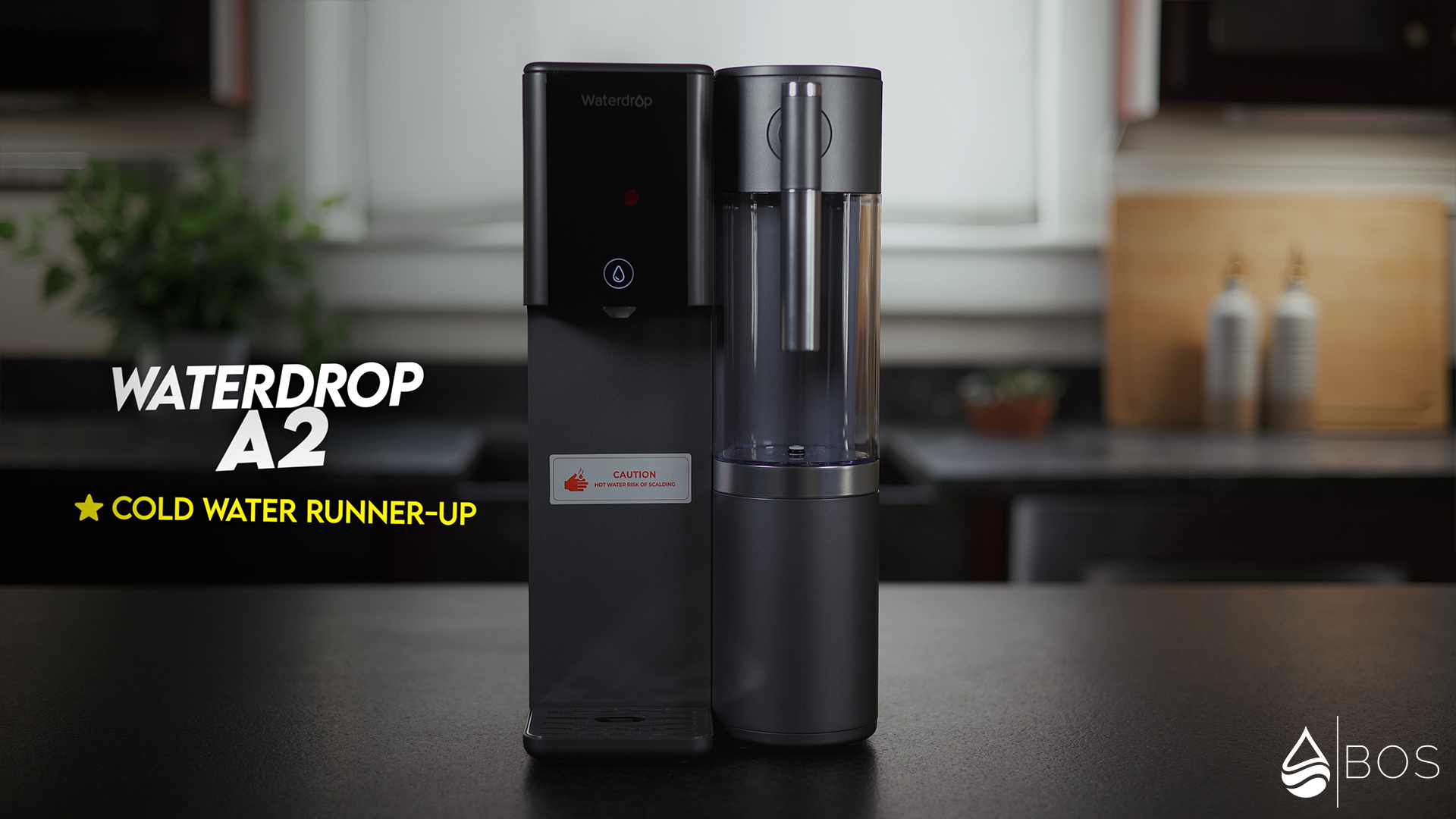
The Waterdrop A2 delivered excellent filtration results and clean-tasting water but lacks NSF/ANSI-certified contaminants and 3rd party testing. Overall, it’s easy to set up, use, and maintain with water/filter change lights and easy tank refills. The carafe provides ~5.3 cups instant ambient water plus fits the fridge. On-demand dispensing with the large touch screen is slower in general (especially for hot water), though volume + temp presets up the convenience. Cold water gets cold enough (~47 °F), but actual yield is only ~16 oz at a time; hottest water (~189 °F) isn’t hot enough for most uses, but there’s lots of it (107 oz in one go). More pros/cons: feels sturdy and looks nice, low wastewater, child safety lock, UV stage, dispensing lights, favorite mode. With below-average upfront and average ongoing costs, this is our 2nd pick for a cold water countertop RO.
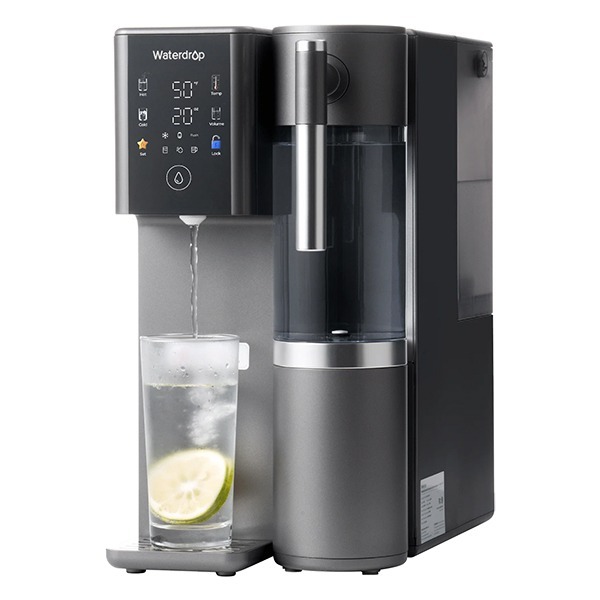
The Waterdrop A2 is a countertop reverse osmosis system that doesn’t require a plumbing connection. It’s designed for use as a drinking water filter to purify municipal tap water and dispense ambient, hot, and cold water.
As usual, we’ve tested the system with our own hands:
- Hands-on experience: We assembled, primed, used, and maintained it.
- Filtration effectiveness: We sent unfiltered and filtered tap water samples to a professional laboratory for analysis to determine real-world contaminant reduction. We also reviewed NSF/ANSI certifications and other available test data.
- More testing: We conducted taste and odor evaluations as well as filtration speed, maximum continuous dispensing, wastewater, and water temperature tests.
- All other product aspects: We considered initial and long-term costs, warranties, additional features, frequent customer complaints, and more.
To learn more about our testing procedure check our editorial guidelines.
Contents
Final Rating: /5.00
FiltrationFiltration score combines our lab results and taste testing with NSF/ANSI certifications and 3rd-party contaminant reduction data.: /5.00
Usability: /5.00
CostsCost scores reflect overall value for money rather than price alone.: /5.00
| Type: | Countertop Reverse Osmosis System (Ambient, Hot & Cold) |
| PriceNo short-term sales. (Nov 4, 2025): | $499 (Use Code WD10BOS for 10% Off!) |
| Yearly CostEstimate is based on rated/claimed filter life and 500 gallons annual water consumption. No short-term sales. (Nov 4, 2025): | ~$70 (Save 10% With Filter Subscription) |
(Use Code WD10BOS for 10% Off!)
Final Rating: /5.00
What We Like Most
- Excellent results in our lab testing.
- Clean taste with no odor.
- Sleek, sturdy build though carafe is lightweight.
- Easy setup/priming with clear illustrated instructions, a quick-start guide, and QR-linked video tutorial.
- Generally suited for daily use with a handy plastic carafe (~5.3 cups) providing instant ambient water + fits in the fridge.
- Large, responsive, intuitive touchscreen to dispense ambient, cold, or hot water without splashing.
- 6 temp presets: Cold, ambient, 113, 149, 185, or 203 °F + custom option (9 °F increments).
- 4 volume presets plus custom option.
- Plenty of hot water (~107 oz) up to 203°F (actual: ~189 °F) in one go.
- Cold water down to 50-59 °F (actual: ~47 °F).
- Easy feed tank refills with water-change indicator.
- Very easy filter changes (quickly click in/out) plus indicator light.
- Low wastewater for a countertop RO.
- Automatic flushing reduces TDS creep and extends RO membrane life.
- Extras: cooling can be turned off, child lock for hot water, favorite mode, UV light, boiling point correction, temperature dispensing light.
- Well below-average upfront price.
What We Don’t Like
- No NSF/ANSI certifications or third-party testing for contaminant reduction.
- Large-sized display font and icons detract from otherwise sleek look.
- Cold dispensing speed is acceptable, but ambient is relatively slow and hot is very slow, though presets help.
- Hottest water only reached ~189 °F in our testing.
- Realistically only ~16 oz of truly cold water per batch (~45 min cooling time).
- Pour ramps down when you press stop, which takes getting used to.
- Automatic flushing may waste water.
- Third-party customer complaints: leaking, setup and flush problems (system gets stuck, repeats or never finishes), hot water not being hot, and cold water not being cold (display showing target temps not matching actual output).
How the Waterdrop A2 Compares to…
17 Other Countertop Reverse Osmosis Systems
In this video, Sara explains why the Waterdrop A2 became our runner-up for cold water among the 18 countertop reverse osmosis systems we tested.
Please note: Our full guide on the best countertop reverse osmosis systems is available here.
Video Chapters + Comparison Sheet
- Link to Comparison Sheet
- 00:00 – Intro
- 00:49 – What’s New
- 01:40 – Our 18 RO Systems
- 04:47 – AquaTru Classic (Pt. 1) + How We Tested
- 13:06 – AquaTru Classic (Pt. 2) + 3 System Types
- 18:05 – AquaTru Classic (Pt. 3)
- 26:19 – AquaTru Carafe + Bluevua ROPOT
- 39:34 – Hot Water: Waterdrop C1H
- 46:16 – Hot & Cold Water: Waterdrop A1
- 53:16 – Remaining Systems (Quick-Fire Round)
- 59:09 – Summary
Full Analysis of the Waterdrop A2
Filtration: /5.00
The Waterdrop A2 countertop RO system scored 4.50/5.00 for filtration. How? Most importantly, it achieved excellent results in our lab testing and the filtered water had a clean taste and no odor. However, it has no NSF/ANSI certifications for contaminant reduction nor any third-party testing.
1. Lab Results: /5.00 (2025)

Remember that our before vs after lab comparison is not an exact science. It’s informational and subject to variability, inaccuracies, and interferences caused by natural fluctuations in water quality, accidental contamination, human error, instrumentation issues, and more. Furthermore, our lab-testing is limited to those contaminants present in our water supplies and at their respective concentrations. As such, it can only give us a general idea for how effective a certain water treatment product might be.
In our lab test comparing an unfiltered and a filtered tap water sample, the Waterdrop A2 could remove 11 undesirable impurities and contaminants to below the minimum detection level (so essentially to 100%): chlorine, bromodichloromethane, dibromochloromethane, chloroform, copper, barium, boron, strontium, iron, nitrate, and fluoride.
Only manganese remained in our water – it was reduced by a poor 37%.
Finally, TDS decreased by 95%. While TDS should not be interpreted independently, as it does not override inadequate removal of individual contaminants, ≥95% TDS reduction is very high and shows that the RO membrane works as intended.
Aside from contaminant reduction, we found zinc (0.00686 ppm) in our filtered water that was not present in the unfiltered water, suggesting potential leaching. That said, zinc is merely an aesthetic impurity which only becomes relevant (e.g., impacting water taste) at a ~730x higher level (5 ppm) than detected in our sample per the EPA secondary standards.
Lab Results Chart
| Potentially Harmful | Aesthetic Issues | Feed Water Level | Filtered Water Level | Reduction Rate | |
| Water Disinfectants | |||||
| Chlorine (mg/L) | ✖ | ✖ | ~2 | 0 | 100% |
| Disinfection Byproducts | |||||
| Bromodichloromethane (µg/L) | ✖ | 19.1 | 0 | 100% | |
| Dibromochloromethane (µg/L) | ✖ | 4.88 | 0 | 100% | |
| Chloroform (µg/L) | ✖ | 50.3 | 0 | 100% | |
| Metals | |||||
| Copper (mg/L) | ✖ | ✖ | 0.0078 | 0 | 100% |
| Iron (mg/L) | ✖ | 0.171 | 0 | 100% | |
| Manganese (mg/L) | ✖ | ✖ | 0.0046 | 0.0029 | 37% |
| Barium (mg/L) | ✖ | 0.0289 | 0 | 100% | |
| Boron (mg/L) | ✖ | 0.0131 | 0 | 100% | |
| Strontium (mg/L) | ✖ | 0.098 | 0 | 100% | |
| Salts | |||||
| Nitrate (N) (mg/L) | ✖ | 3.03 | 0 | 100% | |
| Fluoride (mg/L) | ✖ | 1.04 | 0 | 100% | |
| RO Salt Rejection | |||||
| TDS (mg/L) | ✖ | 462 | 20.9 | 95% | |
| Other Parameters | |||||
| pH | 7.7 | 6.3 | |||
| Impurities NOT Detected in Unfiltered Tap Water Sample | |||||
| Zinc (mg/L) | ✖ | 0 | 0.00686 | ||
| Lab Reports: Filtered Water Report, Unfiltered Water Report
Chlorine Self Test Photos: Filtered Water, Unfiltered Water |
|||||
| Explanation: | |||||
| Full Removal | |||||
| Considerable Reduction | |||||
| Concentration More Than Double of Unfiltered Water Sample | |||||
| Potential Leaching Reached or Exceeded the Strictest Public Health Guideline We Could Find | |||||
2. NSF/ANSI Certifications and Other Test Data
The Waterdrop A2 does not have any NSF/ANSI certifications for contaminant reduction. It also lacks third-party testing for contaminant removal.
3. Filtration Process
We have 1 filter cartridge and a UV light post-filter, which comprise 5 filtration stages:
Stages 1-4 are performed by the composite filter (PP cotton + activated carbon block + RO membrane + taste enhancing layer):
- Stage 1: the PP cotton layer is mechanical filtration, which acts like a sieve to remove solid, undissolved particulates such as dirt or rust.
- Stage 2: the activated carbon block removes things like bad tastes and odors, chlorine/chloramine, disinfection byproducts and other organics, as well as certain metals. Removing chlorine and other contaminants protects the RO membrane from damage. In addition, the block structure provides fine mechanical filtration due to its smaller pore size compared to granular carbon.
- Stage 3 is the RO membrane, which uses reverse osmosis to effectively remove the vast majority of contaminants and minerals.
- Stage 4 is the taste enhancing layer which we assume uses activated carbon.
Stage 5 is the UV post-filter, which exposes the filtered water to germicidal UV radiation prior to dispensing, inactivating microorganisms. This provides chemical-free disinfection; however, in our view, it should not be relied upon to make non-potable water safe to drink, but rather to help control microbial regrowth in stored water and prevent off-tastes from stagnation.
4. Taste and Odor Test
In our test, the filtered water was odorless and had a perfectly clean taste.
Usability: /5.00
The Waterdrop A2 achieved a usability score of 4.25/5.00, based on its performance in the following categories:
- Initial system assembly including filter priming (0.80/0.80)
- Everyday use (2.95/3.70)
- Filter replacements (0.50/0.50)
1. Initial Setup: /0.80
Assembling the Waterdrop is very easy. The user manual contains clear, illustrated instructions and a helpful quick start guide is also provided. In addition, a QR code links to a tutorial video on YouTube.
Here’s a quick breakdown of the setup procedure:
- Place the system on a stable surface with a clearance of at least ~8 inches behind the unit. This space is needed for proper heat dissipation.
- Aligning the marks on the filter and dispenser, insert filter into the designated slot in the dispenser. Press the filter down until a “click” is heard, indicating proper placement.
- Remove the water tank cover and remove the tank. Fill feed water tank with tap water up to max fill line.
- Reinstall feed tank and replace cover, pushing down to secure it in place.
- Plug power cord into an electrical outlet.
- Place a container larger than 52 oz under the spout on the drip tray. The unit will start flushing automatically.
- When the feed water tank is low or the flushing progress reaches 50%, the water tank status indicator light will turn on, prompting you to discard the wastewater in the feed tank, refill with tap water, and replace on the unit.
- The water dispensing button will flash after replacing the feed water; press to resume flushing.
- Flushing will filter water into the pure water tank.
- When the pure water tank is full, the dispense button will flash. Press it; the filtered water will flow back into the machine for internal flushing and then drain out from the outlet. Do not drink the water obtained from this step.
- The feed tank indicator light turns on when the feed tank water is too low. Empty/refill the feed tank. Repeat 3-4 times until the progress bar reaches 100% – now the system is ready for use.
2. Day-to-Day Use: /3.70
2.1 Speed & Water Capacity: /0.98
The Waterdrop A2 is generally suited for daily use. Firstly, its plastic carafe, though quite small, stores ambient water for later – up to ~5.3 cups (~0.33 gal). Consequently, you can fill a 40-oz bottle from the carafe on a single refill all in one pour – no need to refill the feed tank in between or wait for additional cycles of water processing.
Alternatively, you can dispense straight into your glass or bottle with a push of a button, though this pump-driven dispensing speed is much slower than pouring from the carafe – for ambient, cold, and hot water.
We were able to fill our 40-oz bottle directly from the spout without tilting or holding it at an angle. However, you can’t fit a standard 2-quart carafe under the spout, as its height is only 9.5” from the base.
You could still dispense 2 quarts of ambient water without refilling the feed tank, assuming you found a container that would fit – but it would require more than one push of the dispense button.
More specifically, using a full feed tank (~1.31 gal), in our test the system dispensed 50 oz of ambient water in one continuous pour with 6 oz remaining in the carafe – in other words, 56 oz in one go. Therefore, to completely fill a 2-quart carafe, you would need to allow the A2 additional time to process more water to top up the remaining ~8 oz.
The system allowed us to dispense 52 oz on the cold water setting all at once, but the water was only cold for the first 16 oz or so. Since cooling took around 45 minutes, you realistically can only get ~2 cups of refreshingly cold water at one time.
In contrast, the A2 dispensed 107 oz of the hottest water in one continuous pour; volume-wise, this should be plenty for pretty much all typical uses.
We also investigated how much ambient filtered water could be produced from one full feed tank, regardless of how much time or how many button pushes it took to fully process and dispense this entire volume. For the Waterdrop A2, this maximum volume was 113 oz (~14.1 cups). Assuming 25.5 cups or 31.5 cups of daily water consumption for the average US and US-family households, respectively, and 14.1 cups filtered water per full feed tank, we estimate 2-3 daily refills – below-average to average for the countertop ROs we tested.
The Waterdrop A2 also filters fast enough to meet the daily water needs of the average-sized US households, and it can handle thirst bursts. In our ambient water speed tests, it could dispense 1 or 4 cups instantly when poured from a full carafe. Dispensing into a glass is relatively slow, taking 24.5 sec for 1 cup when the water was pre-processed, meaning the feed tank was filled and allowed to filter this water first. Upon refilling the tank, it took 5:11 min to dispense 4 cups of water.
Cold water dispensing speed is acceptable, taking 21 sec to dispense 1 cup of pre-processed water – fairly standard for the cold water countertop RO systems we tested.
Hot water dispensing speed is very slow, requiring 48.5 sec to dispense 1 cup of pre-processed water. Still, this is pretty typical for the hot water countertop RO systems we tested. Hot water is especially slow to dispense because it must be heated on demand; flow must be slow enough to give it time to reach the desired temperature. Of greater concern was the relatively low hot water temperatures obtained during our test – more on that below.
Fortunately, the Waterdrop A2 provides volume presets. This helps to offset the inconvenience of slower dispensing speeds, regardless of water temperature – no need to monitor the pour.
2.2 Dispensing: /0.70
Dispensing ambient or on-demand hot/cold water is simple and splash-free. The A2’s big, responsive touch screen display has an intuitive interface with large font.
As mentioned, you may choose to dispense ambient water directly into your glass or pour from the included plastic carafe. The carafe has a comfortable handle, pours nicely and fits most fridges. Hot and cold water may only be dispensed into a glass.
This system has four volume presets (4, 8, 16, or 20 oz) to choose from, or you can dispense a custom volume in 2 oz increments. There are also 6 temperature presets: Cold, Ambient, 113, 149, 185, or 203 °F. Hot water may also be customized in 9 °F increments from 113 up to 203 °F.
You can stop dispensing early if needed by pushing the dispense button again, but in our test it took a second for the system to ramp down. We think most people would get used to this after a while, but it requires some awareness until you get a sense of the timing. Fortunately, the magnetic drip tray can help catch runoff.
Other helpful features include favorite mode which saves your preferred water temperature and volume. There is also an optional child safety lock to keep your family safe from accidental hot water injuries.
2.3 Hot Water: /0.56
More on the hot water:
The Waterdrop A2 can dispense enough hot water for virtually all typical household use cases – which we define as at least 32 oz at a time. In fact, in our test it could dispense a whopping 107 oz of ~188.8 °F water at one time. In other words, it can produce sufficient hot water for beverages like tea, coffee or hot chocolate (8-16 oz), instant noodles/soup (14-20 oz), and cooking assist/pot jump-start (16–32 oz).
The actual temperature of the dispensed hot water deviated from the presets by 0.6-14.2 °F when tested with our own thermometer. Based off the unit’s presets, we measured (A2 vs. our measurement):
- 113 °F vs. 111.6 °F
- 149 °F vs. 144 °F
- 185 °F vs. 185.6 °F
- 203 °F vs. 188.8 °F
Almost across the board, the Waterdrop struggled to reach the preset levels. Most problematically, it didn’t come anywhere close to the advertised hottest temperature of 203 °F, missing the mark by more than 14 degrees.
Assuming 185–190 °F allows for only limited hot water use, with ≥200 °F being the optimal, kettle-equivalent performance, the A2 simply doesn’t get hot enough for most typical applications.
On the plus side, the system offers optional boiling point correction (high altitude mode), which lowers the max hot water temperature for those living at higher elevations to reduce risk of scalding injuries.
2.4 Cold Water: /0.56
More on the cold water:
Despite continuously dispensing 52 oz of water on the cold setting, only the first ~16 oz were actually chilled after allowing for sufficient cooling time. Consequently, the A2 can dispense about 2 cups of genuinely cold water every 45 minutes, which is enough to fill one person’s glass. However, assuming ≥20 oz enables bottle refills, ≥32 oz supports extended use, and ≥48 oz is needed for multiple people or to fill a carafe, this system is pretty limited in its cold-water capacity.
That said, the dispensed cold water temperature was very accurate when tested with our thermometer – we measured 46-53 °F vs. 46.9-52.9 °F (display vs. our thermometer). Furthermore, Waterdrop advertises a cold water temp of 50-59 °F for the A2. Our test confirms that the system achieves this and then some, at least for the first 16 oz of cold water.
In other words, the A2 succeeds in producing delightfully chilly water – just not very much of it. Considering <41 °F is fridge-cold, with 41–45 °F reaching near-fridge temps and 46-50 °F still feeling refreshingly cold, the A2 achieved solid marks for its ability to produce an invigoratingly cold cup.
Notably, cooling is optional on the Waterdrop A2 and can be activated or inactivated by pressing and holding the water dispensing and cold water buttons simultaneously for 5 seconds.
2.5 Refilling & Size: /0.49
Refilling the Waterdrop A2 is simple, as the feed water tank is easy to remove, refill, and place back on the base. There is also a max fill line on the feed tank and a water shortage/change indicator to remind you when it’s time to empty the wastewater and refill.
Measuring 8.3″x13.6″x14.5″ (WxHxD), the Waterdrop A2 fits under standard height (18”) kitchen cabinets, and at 20.2 lbs, it’s slightly weightier than average for the countertop ROs we tested, though we wouldn’t classify it as heavy. Its footprint is slightly below-average compared to the other tested systems, occupying ~120.35 in2 (~0.84 ft2) – not space-saving but not a counter-hog, either. At more than 8” wide it is not streamlined enough to fit in narrow spots.
2.6 Other: /0.42
There are a handful of other factors that impact the Waterdrop’s overall usability:
- The plastic carafe that stores some water for later and fits in the fridge.
- We like the temperature light that illuminates your glass when dispensing – white for ambient water, red for hot, and blue for cold.
- Noticeably absent are TDS measurements of the feed or filtered water, which normally facilitate monitoring your water quality and the system’s filtration performance over time.
3. Filter Replacements: /0.50
Filter replacements are simple as there’s only one cartridge to replace and it is easily removable thanks to its handle. The new filter simply clicks into its designated slot.
The filter change indicator light on the display also alerts you when it is time to change the filter. Rated filter life is 528 gal or 12 months.
Assuming 500 gallons of yearly water consumption for the average household, we predict the frequency of your filter changes will be dictated by filter age rather than water consumption. Therefore, expect to replace the filter once yearly if following the manufacturer’s recommendations.
However, given the lack of NSF/ANSI certifications for contaminant reduction or third-party testing, we feel more frequent filter changes might be a safer choice. Specifically, a 6-month lifespan may be more realistic for the composite filter. Therefore, filter changes would be required twice yearly.
Support BOS Water’s Mission!
Every coffee helps us test more products and bring you unbiased results!
Costs: /5.00
Based on value for money, the Waterdrop A2 achieved a cost score of 4.42 out of 5.00, indicating it is priced below average for what it offers compared to competing systems (a score of 4.00 represents average value). Notably, while its upfront price is well below-average, its annual filter replacement costs are about average compared to the other ambient/hot/cold water countertop RO systems we tested.
1. Upfront Price
As of November 4, 2025, the Waterdrop A2 is priced at $499. However, Waterdrop frequently offers sales, so you can realistically get the A2 for as little as $409 – well below the $587.71 average across all the tested countertop RO systems that produce ambient/hot/cold water.
Alternatively, you can use our 10% discount code, although it doesn’t stack with sale discounts.
2. Long-Term Expenses for Filter Replacements
Based on 500 gallons consumption and a 528-gal or 12-month rated filter life for the composite filter, we estimate $70 in annual filter replacement costs, which is well below the $149.47 average across all the tested countertop ROs.
However, given the lack of NSF/ANSI certifications or third-party testing for contaminant reduction, replacing the composite filter twice yearly might be a safer choice, which would bring annual filter costs to an about average $140 per year.
You can save 10% with a filter subscription.
3. Product Warranty
The system is covered by a 1-year warranty.
4. Other Cost Factors
Other features which we feel boost the Waterdrop A2’s value include:
- UV light to prevent stagnation of the filtered water.
- Plastic carafe stores water for later, though we would prefer glass.
- Dispensing light that reflects water temperature.
- Child safety lock to prevent hot water injuries.
Additional
1. Pure-to-Drain Ratio Test
We measured a pure-to-drain ratio of ~1:0.49 which is low wastewater for RO systems in general and better than the average ~1:0.61 across the countertop RO systems we tested.
2. Construction
Overall, the unit feels well built, including the sturdy base. The handle on the feed water tank feels like it will hold up to regular use. The hard plastic covers for the filter housing and feed tank are not on hinges and effortlessly pop into place – one less thing to break over time.
While the plastic carafe isn’t flimsy, it is pretty lightweight when empty.
3. Appearance
On the whole the A2’s design is sleek and modern. We like the matte grey color scheme – it looks especially sharp against the clear plastic carafe’s silver accents.
We don’t care for the display’s large font and icons. While it makes the user interface more readable, the font size and icon design appear somewhat unpolished relative to its otherwise smart appearance.
4. Flushing
Automatic flushing is triggered after each water production cycle, 25 minutes of total water production, and 24 hours of non-use. This counters TDS creep and extends RO membrane life but may also waste water.
5. Frequent Customer Complaints
We read about issues with leaking as well as setup and flushing problems – e.g., the system gets stuck, repeats, or never finishes the setup/flush cycle. Other customers complained about temperature issues – hot water not being hot, cold water not being cold – in other words, the display showing target temperatures that do not match the actual output.
We did not experience most of these issues firsthand, although we did notice discrepancies with the hot water not getting as hot as advertised or indicated on the display.
Bottom Line: Runner-Up for Cold Water Countertop RO (/5.00)
Filtration weighted at 60%, and usability and cost at 20% each, the Waterdrop A2 scored a final rating of 4.43 out of 5.00.
This system achieved a great 4.50/5.00 in our filtration analysis. It produced odorless, clean-tasting water and completely removed all but 1 contaminant in our lab tests. However, it lacks both NSF/ANSI-certified contaminants and third-party testing for contaminant reduction.
It’s very simple to set up, use, and maintain, including feed tank refills and filter changes.
A small carafe provides instantly accessible ambient water and fits in the fridge. You can also dispense ambient, hot (4 temp presets or custom), or cold water into a glass via the nice touch screen. In general, dispensing into a glass is slower (especially for hot water) but made more manageable by volume presets.
The A2 dispenses ample hot water but unfortunately it doesn’t get hot enough for most practical uses. Cold water, on the other hand, does get refreshingly cold – but you are limited to about 2 cups at a time. It will pour up to 52 oz on the cold setting in one go, but the water isn’t adequately chilled after the first ~16 oz.
Finally, it has a few useful features – a modern design, filter/water change indicators, low wastewater, a UV light, a child safety lock, favorite mode, high altitude mode, automatic flushing, and a dispensing light (but lacks TDS readings). With below-average upfront and about average ongoing costs, the Waterdrop A2 takes the second place spot for cold water RO system with highly effective filtration.
(Use Code WD10BOS for 10% Off!)
About the Author(s)

Sara has been a lifelong home-improvement fan (she’s been hooked on This Old House since she was five) and taught herself any project she didn’t already know by watching YouTube tutorials. She is also an award-winning filmmaker. Armed with this skillset, Sara installs, primes, samples, uses, and maintains nearly every point-of-use water treatment system we test – then brings her results to life on camera for our YouTube channel.

Raoul has a background in mechanical engineering and has been writing about home water treatment since 2015. He designs our product review processes, analyzes the results, and ties everything together. As editor-in-chief, he tries hard to keep the whole operation running smoothly behind the scenes.