

This page contains affiliate links. Learn more.
Our Verdict (Best For)
The SimPure Y9A achieved excellent results in our lab testing and delivered clean-tasting water. However, it has no NSF/ANSI-certified contaminants and at least some of its 3rd-party testing was not done to full filter life. The system features remineralization. Overall, usability is adequate – setup is easy, we have filter/water change indicators, and easy filter changes. However, it’s a bit noisy and the touchscreen’s fussy. It’s not very fast, as it filters and dispenses in real time (no pure tank). Plus, no volume presets. Still, it’s fast enough to meet daily water demands, providing 1 cup in ~22-27 sec, 4 cups in 1:15 min, and up to 128 oz of water in one go. Wastewater is very low, despite auto-flushing (which extends RO membrane life). With average upfront and slightly higher ongoing costs, it’s a solid countertop RO, but we think there are better systems for the money.
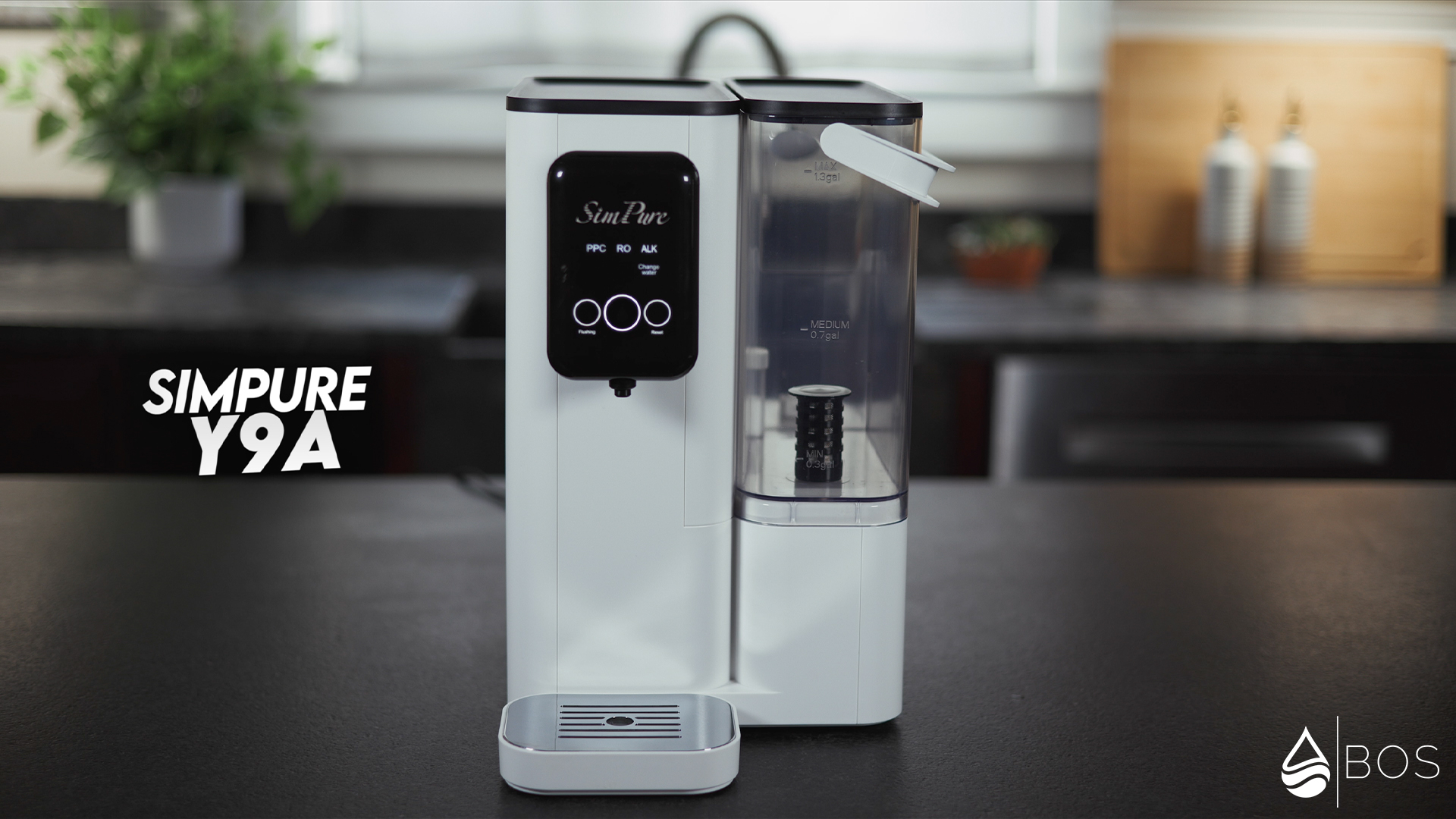
The SimPure Y9A is a countertop reverse osmosis system that doesn’t require a plumbing connection. It’s designed for use as a drinking water filter and can purify both tap water and properly disinfected well water (pre-treatment may be required).
As usual, we’ve tested the system with our own hands:
- Hands-on experience: We assembled, primed, used, and maintained it.
- Filtration effectiveness: We sent unfiltered and filtered tap water samples to a professional laboratory for analysis to determine real-world contaminant reduction. We also reviewed NSF/ANSI certifications and other available test data.
- More testing: We conducted taste and odor evaluations as well as filtration speed, maximum continuous dispensing, and wastewater tests.
- All other product aspects: We considered initial and long-term costs, warranties, additional features, frequent customer complaints, and more.
To learn more about our testing procedure check our editorial guidelines.
Contents

Final Rating: /5.00
FiltrationFiltration score combines our lab results and taste testing with NSF/ANSI certifications and 3rd-party contaminant reduction data.: /5.00
Usability: /5.00
CostsCost scores reflect overall value for money rather than price alone.: /5.00
| Type: | Countertop Reverse Osmosis System |
| PriceNo short-term sales. (Nov 4, 2025): | $439.99 |
| Yearly CostEstimate is based on rated/claimed filter life and 500 gallons annual water consumption. No short-term sales. (Nov 4, 2025): | ~$175 |
Final Rating: /5.00
What We Like Most
- Excellent results in our 2025 lab testing.
- Filtered water tasted perfectly clean with no odor.
- Has third-party testing for contaminant reduction but lacks most organics and at least some wasn’t performed to full filter life.
- Applies remineralization to add healthy minerals back into water after purification.
- Sturdy and well-built.
- Easy to set up and prime with clear, illustrated instructions and a helpful YouTube tutorial.
- Generally suited for daily use.
- A single feed tank can produce up to 128 oz ambient water in one continuous dispense without splashing, includes a magnetic drip tray just in case.
- Fewer-than-average daily refills (easy), plus water shortage/change indicator.
- Easy filter changes: quick twist in/out via side panel, plus filter change indicator lights.
- Automatic and manual flushing extend RO membrane life.
- Very low wastewater for a countertop RO.
- Long 2-year warranty upon product registration (1 year without).
What We Don’t Like
- No NSF/ANSI certifications for contaminant reduction.
- Slower dispensing speed without volume presets and no pure tank or carafe for instantly accessible water.
- Touchscreen not always responsive.
- Grating noise when dispensing.
- Flushing may waste water.
- Slightly above-average maintenance costs.
- Third-party customer complaints include leaking/dripping or bad taste/odor of the filtered water.
How the SimPure Y9A Compares to…
17 Other Countertop Reverse Osmosis Systems
In this video, Sara explains why the SimPure Y9A did not become one of our top picks among the 18 countertop reverse osmosis systems we tested.
Please note: Our full guide on the best countertop reverse osmosis systems is available here.
Video Chapters + Comparison Sheet
- Link to Comparison Sheet
- 00:00 – Intro
- 00:49 – What’s New
- 01:40 – Our 18 RO Systems
- 04:47 – AquaTru Classic (Pt. 1) + How We Tested
- 13:06 – AquaTru Classic (Pt. 2) + 3 System Types
- 18:05 – AquaTru Classic (Pt. 3)
- 26:19 – AquaTru Carafe + Bluevua ROPOT
- 39:34 – Hot Water: Waterdrop C1H
- 46:16 – Hot & Cold Water: Waterdrop A1
- 53:16 – Remaining Systems (Quick-Fire Round)
- 59:09 – Summary
Full Analysis of the SimPure Y9A
Filtration: /5.00
The SimPure Y9A countertop RO system scored 4.50/5.00 for filtration. How? Most importantly, it achieved excellent results in our lab testing and the filtered water was odorless and tasted perfectly clean. However, the system has no NSF/ANSI-certified contaminants; plus, its 3rd party testing for contaminant reduction lacks most organics and at least some wasn’t performed to full filter life.
1. Lab Results: /5.00 (2025)

Remember that our before vs after lab comparison is not an exact science. It’s informational and subject to variability, inaccuracies, and interferences caused by natural fluctuations in water quality, accidental contamination, human error, instrumentation issues, and more. Furthermore, our lab-testing is limited to those contaminants present in our water supplies and at their respective concentrations. As such, it can only give us a general idea for how effective a certain water treatment product might be.
In our lab test comparing an unfiltered and a filtered tap water sample, the SimPure Y9A could remove 10 undesirable impurities and contaminants to below the minimum detection level (so essentially to 100%): chlorine, bromodichloromethane, dibromochloromethane, chloroform, copper, strontium, iron, manganese, nitrate, and fluoride.
The following substances remained in our water:
- Barium was reduced by a very high 96%.
- Boron was also reduced by a very high 94%.
Finally, TDS decreased by 93%. While TDS should not be interpreted independently, as it does not override inadequate removal of individual contaminants, ≥90% TDS reduction is high and shows that the RO membrane works as intended. That said, the Y9A features remineralization which adds beneficial minerals back into the water and increases its TDS. Consequently, we actually expect a slightly lower amount of TDS removal in this setting.
Remineralization Results
We measured 1.18 ppm magnesium and 1.17 ppm calcium post-filtration, neither of which were within their respective WHO health guidelines (minimum 10 ppm, optimal 20-30 ppm for magnesium and minimum 20 ppm, optimal ~50 ppm for calcium). While these levels were higher than those observed in the non-remineralized RO systems we tested (average of 0.11123 ppm magnesium and 0.47253 ppm calcium), they still reflect limited mineral restoration.
Although pH should not be interpreted as an indicator of adequate mineral content in general, post-remineralization it slightly increased to 7.1 (compared to an average of 6.72 without remineralization), and alkalinity rose to 8 ppm – considerably lower than the IDPH-recommended range of 30–400 ppm but higher than the 2.2 ppm average of non-remineralized systems.
Overall, the mineral cartridge minimally improved buffering capacity and taste-related parameters, but did not meaningfully restore essential minerals to health-recommended levels.
That said, our remineralization lab results represent a standardized, worst-case scenario designed to reflect the shortest possible contact time between purified RO water and remineralization media, ensuring consistency across all tested systems. Additional testing using TDS meters and extended contact times showed considerably higher TDS levels, suggesting increased mineral dissolution under those conditions. This minimal-contact approach may therefore underrepresent real-world remineralization performance.
In the SimPure Y9A, water is remineralized inline before dispensing. A small amount of purified water remains in and around the internal mineral cartridge after each use. If the unit sits idle, that water stays in contact with the media longer, which may allow additional mineral dissolution.
Users who dispense small amounts at a time and allow the system to rest between uses may therefore see somewhat higher mineral levels than observed under our minimal-contact lab conditions. In contrast, dispensing larger volumes at once results in shorter contact time and performance closer to our test results.
We did not measure the cartridge’s internal hold-up volume, so while real-world mineral levels may exceed our lab findings under certain usage patterns, the extent of that increase remains unknown.
Lab Results Charts
| Potentially Harmful | Aesthetic Issues | Feed Water Level | Filtered Water Level | Reduction Rate | |
| Water Disinfectants | |||||
| Chlorine (mg/L) | ✖ | ✖ | ~2 | 0 | 100% |
| Disinfection Byproducts | |||||
| Bromodichloromethane (µg/L) | ✖ | 12.6 | 0 | 100% | |
| Dibromochloromethane (µg/L) | ✖ | 3.05 | 0 | 100% | |
| Chloroform (µg/L) | ✖ | 30.6 | 0 | 100% | |
| Metals | |||||
| Copper (mg/L) | ✖ | ✖ | 0.0086 | 0 | 100% |
| Iron (mg/L) | ✖ | 0.076 | 0 | 100% | |
| Manganese (mg/L) | ✖ | ✖ | 0.0068 | 0 | 100% |
| Barium (mg/L) | ✖ | 0.0363 | 0.0013 | 96% | |
| Boron (mg/L) | ✖ | 0.111 | 0.00661 | 94% | |
| Strontium (mg/L) | ✖ | 0.116 | 0 | 100% | |
| Salts | |||||
| Nitrate (N) (mg/L) | ✖ | 3.18 | 0 | 100% | |
| Fluoride (mg/L) | ✖ | 0.989 | 0 | 100% | |
| RO Salt Rejection | |||||
| TDS (mg/L) | ✖ | 455 | 29.8 | 93% (Uses Remineralization) | |
| Other Parameters | |||||
| pH | 7.6 | 7.1 | |||
| Impurities NOT Detected in Unfiltered Tap Water Sample | |||||
| Lab Reports: Filtered Water Report, Unfiltered Water Report | |||||
| Chlorine Self Test Photos: Filtered Water, Unfiltered Water | |||||
| Explanation: | |||||
| Full Removal | |||||
| Considerable Reduction | |||||
| Concentration More Than Double of Unfiltered Water Sample | |||||
| Potential Leaching Reached or Exceeded the Strictest Public Health Guideline We Could Find | |||||
| SimPure Y9A | Health Guidelines | Average of Non-Remineralization Countertop RO Systems We Tested |
|
| Minerals | |||
| Magnesium (mg/L) | 1.18 | Minimum Level: 10 Optimum Level: 20-30 Source: WHO |
0.11123 |
| Calcium (mg/L) | 1.17 | Minimum Level: 20 Optimum Level: ~50 Source: WHO |
0.47253 |
| pH & Alkalinity | |||
| pH | 7.1 | No Health Guideline | 6.72 |
| Alkalinity (mg/L) | 8 | 30 to 400 (IDPH) | 2.2 |
| Lab Reports: Filtered Water Report, Unfiltered Water Report | |||
| Explanation: | |||
| Within Range of Health Guideline | |||
| Not Within Range of Health Guideline | |||
2. NSF/ANSI Certifications and Other Test Data
The SimPure has no NSF/ANSI certifications for contaminant reduction.
While it has 3rd party testing for the reduction of 17 contaminants, it lacks most organics, it doesn’t reference NSF/ANSI standards for all impurities, and at least some wasn’t performed to full filter life.
Reported reduction rates include:
- TDS (99.88%)
- Total Chromium (>99.70%)
- Cadmium (>99.46%)
- PFOA (>99.09%)
- PFOS (>98.78%)
- Total coliforms (>99.99%)
- Fluoride (>99.89)
- Nitrate (99.96%)
- Arsenic (>99.94%)
- Lead (>99.88%)
- Mercury (>98.47%)
- Copper (>99.83%)
- Barium (>99.53%)
- Selenium (>99.19%)
- Chlorate (>90.90%)
- Dissociate chlorine residue (>99.47%)
Reduction rates are per SimPure’s test reports.
3. Filtration Process
We have a filter screen, 2 filter cartridges and a UV-C light which comprise 6 filtration stages:
- Stage 1 is a stainless steel mesh filter screen inserted in the bottom of the feed tank, which performs mechanical filtration to remove solid, undissolved particulates such as sediment, dirt or rust.
- Stages 2+3 is the composite pre-filter (PP + activated carbon). Like the stage 1 mesh, the PP pre-filter also performs mechanical filtration, acting like a sieve to remove larger particulates. Activated carbon removes things like bad tastes and odors, chlorine/chloramine, disinfection byproducts and other organics, as well as certain metals. By removing chlorine and other contaminants, this pre-filter protects the RO membrane from damage.
- Stage 4 is performed by the RO membrane, which uses reverse osmosis to effectively remove the vast majority of contaminants and minerals.
- Stage 5 is the remineralization post-filter, which restores minerals like calcium, magnesium, and potassium, raises the pH, and boosts the water’s flavor.
- Stage 6 is a UV post-filter which exposes the filtered water to germicidal UVC radiation prior to dispensing, inactivating microorganisms. This provides chemical-free disinfection; however, in our view, it should not be relied upon to make non-potable water safe to drink, but rather to help control microbial regrowth in stored water and prevent off-tastes from stagnation.
4. Taste and Odor Tests
In our test, the filtered water was odorless and had a perfectly clean taste.
Usability: /5.00
The SimPure achieved a usability score of 3.53/5.00, based on its performance in the following categories:
- Initial system assembly including filter priming (0.80/0.80)
- Everyday use (2.23/3.70)
- Filter replacements (0.50/0.50)
1. Initial Setup: /0.80
Assembling the SimPure is easy. In addition to clear, illustrated directions in the user manual, there is a tutorial video on YouTube.
Here’s a quick breakdown of the setup procedure:
- Install drip tray beneath the spout; note that the filters come pre-installed.
- Remove, rinse, and fill the feed water tank with tap water to the MAX level, then reinstall into the base and close the cover.
- Place a large container on the drip tray and have another ready to alternate.
- Plug the power cord into a power outlet to turn unit on; all indicator lights will turn on briefly.
- The system will automatically begin flushing the membrane for 30 seconds – this process is internal and the water will be returned to the feed tank.
- Press the “Dispense” button; you will hear a beep. The system will continuously filter and dispense pure water until the feed water tank reaches the minimum water level. You can press again to stop if needed.
- The “Change Water” indicator will light up when the feed water tank reaches the minimum water level. Empty the remaining water in the feed tank and refill it.
- Repeat steps 6-7 for a minimum of 3-5 cycles to fully flush out the filter cartridges.
- Now your system is ready to use.
2. Day-to-Day Use: /3.70
2.1 Speed & Water Capacity: /1.40
The Y9A is generally suited for daily use to produce ambient water. However, the system lacks a carafe or pure tank for instantly-accessible water, and its pump-driven dispensing speed is relatively slow – not uncommon for this type of RO system. Plus, it lacks volume presets which normally help offset the tediousness of waiting on the slower dispense.
On the plus side, you can fill a 40-oz bottle from a single feed tank all in one continuous dispense – no need to refill the feed tank in-between. However, we had to tilt our bottle to get it to fit under the spout, as its height is fairly low – only 7.75” from the base.
Likewise, you can’t fit a standard 2-quart carafe under the spout, as it’s not high enough. However, assuming you found a container that would fit, you could still dispense 2 quarts in a single button push without refilling the feed tank.
By design, the maximum amount of water that can be dispensed by the SimPure at one time also happens to be the amount of filtered water produced by a single full feed tank. In our test, 128 oz (16 cups) of ambient water could be dispensed all in one continuous pour.
Assuming 25.5 cups or 31.5 cups of daily water consumption for the average US and US-family households, respectively, and ~16 cups filtered water per full feed tank, we estimate 2 daily refills – fewer than average for the countertop ROs we tested.
Even for a relatively slow pump-driven system, the SimPure still filters fast enough to meet the daily water needs of the average-sized US households, and it can handle thirst bursts. In our ambient water speed tests, it could dispense 1 cup in ~22-27 sec and 4 cups in 1:15 min.
Note: The system doesn’t pre-process the water. Therefore, dispensing speed is not influenced by whether you just refilled an empty feed tank.
2.2 Dispensing: /1.00
Dispensing water is easy and splash-free and there’s no ramp up or down to the pour. It dispenses as soon as the button is activated, and stops immediately when the button is pushed again to stop. That said, the simple-to-use touch screen is not always responsive – in our test, we had to push the screen harder than the other tested systems to get it to engage.
You can dispense your desired volume using the “Dispense” button – simply press once to start and once to stop. As mentioned before, there are no volume presets, which is a bit frustrating. However, the magnetic drip tray to catch excess runoff is a nice bonus.
2.3 Refilling & Size: /0.70
Refilling is straightforward. The feed water tank is easy to remove, refill, and place back on the base because it is located on the side of the unit. “Max,” “Medium,” and “Min.” fill lines also ensure you add the appropriate amount of water every time.
It’s also simple to keep track of when it’s time to empty the wastewater and refill the feed tank, as the system has a water shortage/change indicator light on the LED display.
Measuring 9.25″x14.25″x14.2″ (WxHxD), the SimPure fits under standard height (18”) kitchen cabinets, and at 19.8 lbs, it’s a bit weightier than the average countertop ROs we tested – though we wouldn’t describe it as “heavy.” Its footprint is about average compared to the other tested systems, occupying 131.35 in2 (~0.91 ft2), and at over 9” wide it is not streamlined enough to fit in narrow spaces.
2.3 Other: /0.60
The SimPure doesn’t provide TDS readings and, as already mentioned, there is no portable clean water tank, which lowered its usability score in our analysis. What’s more, it makes an unpleasant grating noise when dispensing. It’s not too loud, but it does detract from the user experience.
3. Filter Replacements: /0.50
Filter replacements are simple, though we did have to consult the user manual to figure out how to remove the side panel to do so. The filters are easily accessible and quickly twist in/out. The manufacturer recommends draining the filters before changing them, which takes about 5 minutes. Otherwise, you may get some water leakage when you remove the old filters.
The filter change indicator lights on the control panel alert you when it is time to change each filter. Rated filter life for the composite pre-filter and remineralization post-filter is 6 months and the RO membrane is 9 months. Therefore, expect to replace these components every 6-9 months as indicated. We feel this is a reasonably accurate estimate of filter lifespan, assuming 500 gallons of yearly water consumption for the average household.
Support BOS Water’s Mission!
Every coffee helps us test more products and bring you unbiased results!
Costs: /5.00
Based on value for money, the SimPure Y9A achieved a cost score of 3.78 out of 5.00, indicating it is priced above average for what it offers compared to competing systems (a score of 4.00 represents average value). Notably, while its upfront price is around average, annual filter replacement costs are slightly above-average for the countertop RO systems we tested.
1. Upfront Price
As of November 4, 2025, the SimPure is priced at $439.99. However, the manufacturer frequently offers sales and so you can purchase the Y9A for as little as $339.99. This is around the $321.89 average across all the ambient-only countertop RO systems we tested.
2. Long-Term Expenses for Filter Replacements
Based on 500 gallons consumption and a 6-month filter life (composite pre-filter and remineralization post-filter) and a 9-month RO membrane life, we estimate $175 in annual filter replacement costs, which is slightly above the $149.47 average across all the countertop ROs we tested.
3. Product Warranty
The system is covered by a 1-year warranty. However, this is increased to a longer 2-year warranty upon product registration.
4. Other Cost Factors
- We have UV post-treatment.
Additional
1. Pure-to-Drain Ratio Test
We measured a pure-to-drain ratio of ~1:0.39, which is very low wastewater for RO systems in general and better than the average ~1:0.61 across the countertop RO systems we tested.
2. Construction
The system feels sturdy and well built.
3. Flushing
This system performs automatic flushing for 30 seconds when powering it on (plugging in) and for 8 seconds after stopping each dispense. You can also manually flush the RO membrane for 30 seconds or up to 5 minutes using the “Flushing” button.
While flushing counters TDS creep and extends RO membrane life, it may also waste water; however, the manufacturer states this process is internal and the flushed water will return to the feed tank for recirculation. They also recommend manual flushing daily or weekly to extend the life of the filter cartridges.
4. Frequent Customer Complaints
We read about issues with leaking and dripping. Other customers complained of water with a bad taste or odor.
We did not experience these issues firsthand.
Bottom Line: Solid But No Match for the Best Countertop ROs (/5.00)
Filtration weighted at 60%, and usability and cost at 20% each, the SimPure Y9A scored a final rating of 4.16 out of 5.00.
The SimPure Y9A performed excellently in our lab testing, applies remineralization, and produced clean-tasting water. However, it lacks NSF/ANSI-certified contaminants, and at least some of its third-party testing was not done to full filter life.
Usability is also ho-hum; without a pure tank or carafe, the system filters and dispenses water in real time. In other words, it’s a bit slow – no instantly accessible water here – and no volume presets to offset that inconvenience. Though not speedy, it’s still fast enough to meet the daily water demands of most households, and requires fewer refills than average for a countertop RO. The touchscreen is a little glitchy though simple to navigate and offers helpful filter/water change indicators. It’s slightly noisy but otherwise easy to maintain and use and has low wastewater to boot.
With average upfront and slightly higher ongoing costs, we feel this system is solid but there are better options for the money.
Further Reading
About the Author(s)

Sara has been a lifelong home-improvement fan (she’s been hooked on This Old House since she was five) and taught herself any project she didn’t already know by watching YouTube tutorials. She is also an award-winning filmmaker. Armed with this skillset, Sara installs, primes, samples, uses, and maintains nearly every point-of-use water treatment systems we test – then brings her results to life on camera for our YouTube channel.

Raoul has a background in mechanical engineering and has been writing about home water treatment since 2015. He designs our product review processes, analyzes the results, and ties everything together. As editor-in-chief, he tries hard to keep the whole operation running smoothly behind the scenes.