

This page contains affiliate links. Learn more.
Our Verdict (Best For)
The Crystal Quest achieved poor lab results but provided clean-tasting water; it also lacks NSF/ANSI-certified contaminants and 3rd party testing. Plus it showed potential zinc leaching above the EPA’s aesthetic guidelines (copper below strictest health guidelines). Setup and maintenance are easy enough, though the manual is sparse and initial filter priming instructions nonexistent. The biggest pitfall: extremely slow dispensing. With on-demand inline filtration and no storage tank or carafe, it takes 1:12 hours to produce 1 cup of ambient water – making the system impractical for virtually all uses. More cons: unappealing look, unclear filter lives and no change lights, very high wastewater, fits standard faucets only. With average upfront and slightly above-average ongoing costs, the Crystal Quest is not a countertop RO that we would recommend.
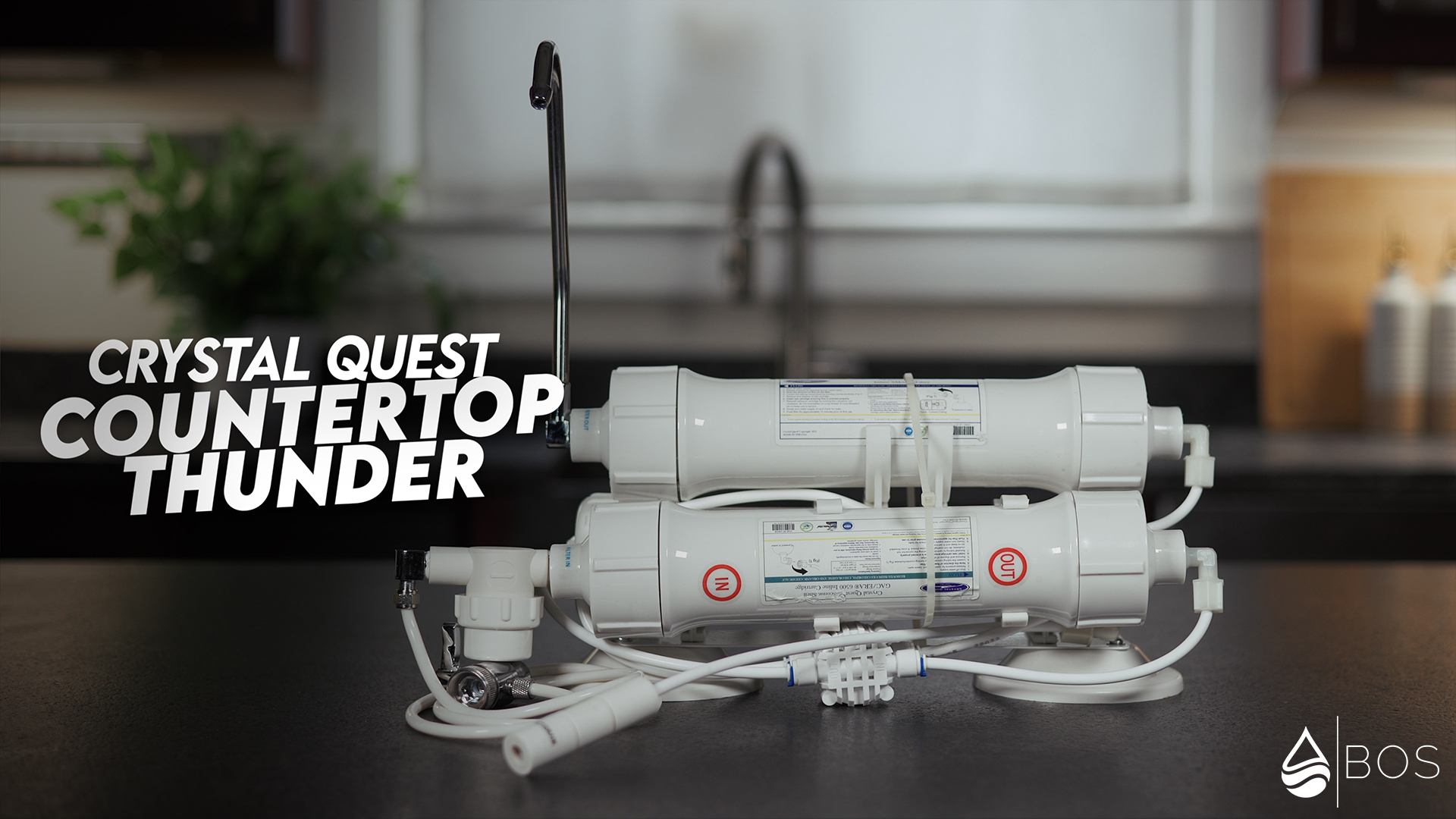
The Crystal Quest Countertop Thunder is a countertop reverse osmosis system that attaches directly to the kitchen faucet. It’s designed for use as a drinking water filter and can purify both tap water and properly disinfected well water (pre-treatment may be required).
As usual, we’ve tested the system with our own hands:
- Hands-on experience: We assembled, primed, used, and maintained it.
- Filtration effectiveness: We sent unfiltered and filtered tap water samples to a professional laboratory for analysis to determine real-world contaminant reduction. We also reviewed NSF/ANSI certifications and other available test data.
- More testing: We conducted taste and odor evaluations as well as filtration speed and wastewater tests.
- All other product aspects: We considered initial and long-term costs, warranties, additional features, frequent customer complaints, and more.
To learn more about our testing procedure check our editorial guidelines.
Contents

Final Rating: /5.00
FiltrationFiltration score combines our lab results and taste testing with NSF/ANSI certifications and 3rd-party contaminant reduction data.: /5.00
Usability: /5.00
CostsCost scores reflect overall value for money rather than price alone.: /5.00
| Type: | Faucet-Mounted Countertop Reverse Osmosis System |
| PriceNo short-term sales. (Nov 4, 2025): | $202.23 (Use Code BOS5OFF for 5% Off!) |
| Yearly CostEstimate is based on rated/claimed filter life and 500 gallons annual water consumption. No short-term sales. (Nov 4, 2025): | ~$185 (Save 5% With Filter Subscription) |
(Use Code BOS5OFF for 5% Off!)
Final Rating: /5.00
What We Like Most
- Odorless water with a clean taste.
- Lightweight and thus easier to move around the sink.
- Faucet connector allows you to easily switch between filtered & unfiltered water.
- Filter replacements are fairly simple but parts move around a bit due to the design (a filter wrench is included).
What We Don’t Like
- Achieved poor results in our lab testing.
- Higher level of copper (below strictest health guideline) + extremely high level of zinc (above aesthetic guideline) detected in filtered water.
- No NSF/ANSI certifications or third-party testing for contaminant reduction.
- Easy to attach to kitchen faucet (2 adapters included), but poor instructions with small font, only few illustrations, and no priming directions – online manual easier to read.
- Only compatible with standard kitchen faucets.
- Very bare-bones design with all filters exposed.
- No pure tank or carafe for instantly accessible water.
- Filtration speed is extremely slow and impractical for daily use: ~1:12 hr to filter 1 cup.
- Hard to find convenient place for the system – tubes get in the way of normal sink use.
- Filter lives aren’t specified and no filter change indicators.
- Very high wastewater for a countertop RO.
- Slightly above-average annual filter replacement costs.
- Third-party customer complaints: poor customer service/return policies, extremely slow flow, and weak filtration.
How the Crystal Quest Countertop Thunder Compares to…
17 Other Countertop Reverse Osmosis Systems
In this video, Sara explains why the Crystal Quest Countertop Thunder did not become one of our top picks among the 18 countertop reverse osmosis systems we tested.
Please note: Our full guide on the best countertop reverse osmosis systems is available here.
Video Chapters + Comparison Sheet
- Link to Comparison Sheet
- 00:00 – Intro
- 00:49 – What’s New
- 01:40 – Our 18 RO Systems
- 04:47 – AquaTru Classic (Pt. 1) + How We Tested
- 13:06 – AquaTru Classic (Pt. 2) + 3 System Types
- 18:05 – AquaTru Classic (Pt. 3)
- 26:19 – AquaTru Carafe + Bluevua ROPOT
- 39:34 – Hot Water: Waterdrop C1H
- 46:16 – Hot & Cold Water: Waterdrop A1
- 53:16 – Remaining Systems (Quick-Fire Round)
- 59:09 – Summary
Full Analysis of the Crystal Quest Countertop Thunder
Filtration: /5.00
The Crystal Quest Countertop Thunder scored 2.44/5.00 for filtration. How? Most importantly, it achieved poor results in our lab testing though the filtered water was odorless and tasted clean. In addition, the system has no NSF/ANSI-certified contaminants or 3rd party testing for contaminant reduction.
1. Lab Results: /5.00 (2024)

Remember that our before vs after lab comparison is not an exact science. It’s informational and subject to variability, inaccuracies, and interferences caused by natural fluctuations in water quality, accidental contamination, human error, instrumentation issues, and more. Furthermore, our lab-testing is limited to those contaminants present in our water supplies and at their respective concentrations. As such, it can only give us a general idea for how effective a certain water treatment product might be.
In our lab test comparing an unfiltered and a filtered tap water sample, the Crystal Quest could remove 6 undesirable impurities and contaminants to below the minimum detection level (so essentially to 100%): chlorine, bromodichloromethane, bromoform, dibromochloromethane, chloroform, and barium.
The following substances remained in our water:
- Copper increased by 800%, which is strongly suggestive of potential leaching from the KDF filter media which is a copper-zinc alloy. While not ideal, copper is an essential dietary element for humans, and at 0.09 ppm it was still 3.3x lower than the strictest public health guideline of 0.3 ppm published by the OEHHA. Incomplete priming may have contributed to this leaching. The installation instructions do not mention priming, although the filter replacement instructions do. While we ran water through the system before sampling, the flushed volume may not have been sufficient to fully rinse the media. This may also help explain some of the other lab results observed.
- Boron was reduced by a moderate 60%.
- Lithium increased by 100%, which seems concerning at first. However, lithium was found near the analytical detection limit (0.01 ppm), so this percentage change reflects a minimal absolute difference and could also represent natural fluctuations. As there is no filter media that contains lithium, we don’t expect the Crystal Quest to add lithium to the water but it may not reduce it, either.
- Strontium was reduced by 92%, which is very high.
- Iron was reduced by 0%.
- Aluminum was also reduced by 0%.
- Zinc increased by 78,450%, which is again extremely suggestive of potential leaching from the KDF filter media. As noted above, incomplete priming and insufficient flushing of the media before sampling may have contributed to this result. While zinc is considered an aesthetic impurity, at its measured level of 15.71 ppm it is more than 3x higher than the EPA secondary standard of 5 ppm. At this concentration, it could be expected to negatively impact water taste. Plus, extremely high concentrations of zinc may also have adverse health consequences, such as gastrointestinal distress.
- Fluoride increased by 12%. This may represent natural variability – it’s unlikely that the Crystal Quest adds fluoride to the water, as there’s no fluoride-based filter media. That said, our 2024 fluoride test method is known to be susceptible to alkalinity interference, with higher alkalinity producing artificially elevated fluoride readings. Because the filtered water showed increased alkalinity, it’s possible that this apparent fluoride increase is not real. At the same time, it’s also possible that the Crystal Quest is not effective at fluoride reduction.
Finally, TDS increased by 132%, which perhaps is not surprising given the evidence of potential leaching mentioned above. While TDS should not be interpreted independently of individual contaminant reduction rates, effective RO systems should decrease TDS, ideally by more than 85-90% (making allowances for systems that perform remineralization).
Aside from contaminant reduction, we found manganese (0.03 ppm) in the filtered water that was not present in the unfiltered water, suggesting potential leaching. Manganese is an essential trace mineral that is needed in small amounts for overall health, but too much can be harmful. It was detected above the 0.02 ppm notification level of the OEHHA but below the 0.1 ppm guideline released by the MN Dept. of Health.
Lab Results Chart
| Potentially Harmful | Aesthetic Issues | Feed Water Level | Filtered Water Level | Reduction Rate | |
| Water Disinfectants | |||||
| Chlorine (mg/L) | ✖ | ✖ | 0.44 | 0 | 100% |
| Disinfection Byproducts | |||||
| Bromodichloromethane (µg/L) | ✖ | 2.68 | 0 | 100% | |
| Bromoform (µg/L) | ✖ | 4.42 | 0 | 100% | |
| Dibromochloromethane (µg/L) | ✖ | 5.32 | 0 | 100% | |
| Chloroform (µg/L) | ✖ | 1.36 | 0 | 100% | |
| Metals | |||||
| Copper (mg/L) | ✖ | ✖ | 0.01 | 0.09 | 800% Increase |
| Iron (mg/L) | ✖ | 0.01 | 0.01 | 0% | |
| Aluminum (mg/L) | ✖ | ✖ | 0.01 | 0.01 | 0% |
| Barium (mg/L) | ✖ | 0.05 | 0 | 100% | |
| Boron (mg/L) | ✖ | 0.1 | 0.04 | 60% | |
| Zinc (mg/L) | ✖ | 0.02 | 15.71 | 78,450% Increase | |
| Lithium (mg/L) | ✖ | 0.01 | 0.02 | 100% Increase | |
| Strontium (mg/L) | ✖ | 0.53 | 0.04 | 92% | |
| Salts | |||||
| Fluoride (mg/L) (Flawed?) | ✖ | 0.42 | 0.47 | 12% Increase | |
| RO Salt Rejection | |||||
| TDS (mg/L) | ✖ | 395.2 | 917.4 | 132% Increase | |
| Other Parameters | |||||
| pH | 7.86 | 7.43 | |||
| Impurities NOT Detected in Unfiltered Tap Water Sample | |||||
| Manganese (mg/L) | ✖ | ✖ | 0 | 0.03 | |
| Lab Reports: Filtered Water Report, Unfiltered Water Report | |||||
| Explanation: | |||||
| Full Removal | |||||
| Considerable Reduction | |||||
| Concentration More Than Double of Unfiltered Water Sample | |||||
| Potential Leaching Reached or Exceeded the Strictest Public Health Guideline We Could Find | |||||
2. NSF/ANSI Certifications and Other Test Data
The Crystal Quest does not have any NSF/ANSI certifications for contaminant reduction. It also lacks third-party testing for contaminant removal.
3. Filtration Process
We have 3 filter cartridges (a pre-filter cartridge, the RO membrane, and a post-filter cartridge) which comprise 10 filtration stages.
- Stages 1+3+5+10 are 1-micron sediment filter pads. These pads perform mechanical filtration, acting like a sieve to remove solid, undissolved particulates such as silt or rust.
- Stage 2 is a layer of granular activated carbon, which removes things like bad tastes and odors, chlorine/chloramine, disinfection byproducts and other organics, as well as certain metals. Removing chlorine and other contaminants protects the RO membrane from damage.
- Stage 4 is the RO membrane, which uses reverse osmosis to effectively remove the vast majority of contaminants and minerals.
- Stages 6 + 7 are comprised of two separate beds of KDF resin, a copper-zinc alloy which also removes chlorine and certain water-soluble heavy metals such as lead, mercury, and iron. Additionally, it targets hydrogen sulfide and inhibits microbial growth.
- Stage 8 is a layer of ion exchange resin, which targets dissolved, unwanted ions in the water.
- Stage 9 is an additional layer of granular activated carbon.
4. Taste and Odor Test
In our test, the filtered water was odorless and had a perfectly clean taste.
Usability: /5.00
The Crystal Quest achieved a usability score of 0.70/5.00, based on its performance in the following categories:
- Initial system assembly including filter priming (0.60/0.80)
- Everyday use (0.00/3.70)
- Filter replacements (0.10/0.50)
1. Initial Setup: /0.80
Setting up the Crystal Quest is not as straightforward as with other countertop ROs. To start, the tiny font in the small user manual is very hard to read. Looking up the instructions online was much easier than trying to get through the printed directions.
Overall, the user manual feels a bit disorganized, low-effort, and somewhat incomplete. For instance, there was no information regarding filter priming upon first use. There are not a lot of illustrations, either. We think it may be challenging for someone new to water filters to get started.
That said, it was easy to attach the system to our kitchen faucet using one of the two included adapters. However, it is only compatible with standard kitchen faucets.
Here’s a quick breakdown of the setup procedure:
- Remove the red cap.
- Remove the aerator from the faucet.
- Determine whether you need an adapter for your faucet and choose the correct one as required.
- Attach the diverter to the faucet and turn until tight.
- Using the large clamp, tighten the hose to the faucet.
- Place the Crystal Quest unit on the countertop in your chosen location. Insert the spout into the housing, pushing down firmly.
- Note: user manual does not state whether flushing of the new system is required upon initial setup. However, it does state to flush 4-5 gallons of water through the filter(s) after filter changes.
- Now your system is ready to use.
2. Day-to-Day Use: /3.70
2.1 Speed & Water Capacity: /1.40
In our opinion, the Crystal Quest Countertop Thunder is impractical and ill-suited for daily use. That’s because filtration speed is extremely slow, taking 1:12 hours to dispense 1 cup of ambient water in our speed test, resulting in an overall day-to-day score of 0 and all day-to-day subscores being set to 0.
In theory, you could fill a 40-oz bottle or even a 2-quart carafe in one continuous dispense, as the system processes and dispenses the water directly from your faucet – you are not limited by feed/filtered tank capacities.
However, it filters so slowly that it would take you around 6 hours to fill a 40 oz bottle – closer to 10 to fill a 2-quart carafe – based on our calculations. This renders it virtually unusable for most households and scenarios.
2.2 Dispensing: /1.00
Dispensing ambient water is painstakingly slow and very frustrating. While the faucet connector switch allows you to easily toggle between filtered and unfiltered water, the filtered water is produced one drop at a time.
2.3 Refilling & Size: /0.70
Refills are not needed with the Crystal Quest, as it does not utilize a feed tank. Instead, it processes water in real time as it is dispensed from your faucet.
Measuring 16″x7″x7″ (WxHxD), the unit easily fits under standard height (18”) kitchen cabinets, and at a slight 7.8 lbs, it is extremely lightweight. Its footprint is also smaller than average compared to the other tested systems, occupying ~112.00 in2 (~0.78 ft2).
2.4 Other: /0.60
One other factor we feel affects the Crystal Quest’s usability is that we found it hard to find a convenient place for this system, as the tubes can get in the way of normal sink use.
3. Filter Replacements: /0.50
Filter replacements are fairly easy but the parts move around a bit due to the unit’s design. However, a filter wrench is included to assist you.
This system lacks filter change indicator lights to remind you when it is time to change each filter. Also, Crystal Quest does not specify the expected filter life of the 3 cartridges.
A 6-month rated filter life is fairly standard for pre-filters across most countertop RO systems, including those that come with more thorough testing. Also, a 2-year RO membrane and 12-month post-filter life is customary across countertop ROs. As such, you would have to change the various components every 6-24 months.
Support BOS Water’s Mission!
Every coffee helps us test more products and bring you unbiased results!
Costs: /5.00
Based on value for money, the Crystal Quest achieved a cost score of 3.58 out of 5.00, indicating it is priced above average for what it offers compared to competing systems (a score of 4.00 represents average value). Notably, its upfront price is around the average of similar tankless countertop RO systems, but its annual filter replacement costs are slightly above average compared to all the other countertop ROs we tested.
1. Upfront Price
As of November 4, 2025, the Crystal Quest is priced at $202.23. However, applying our 5% off discount code lowers the price to $192.12, which is around the $175 average we observed across tankless countertop RO systems during our research.
2. Long-Term Expenses for Filter Replacements
Based on 500 gallons consumption and an estimated 6 months life for the pre-filter, 2 years for the RO membrane, and 12 months for the post-filter, we estimate $185 in annual filter replacement costs, which is slightly above the $149.47 average across all the tested countertop ROs.
That said, you can save 5% with a filter subscription.
3. Product Warranty
The system is covered by a 1-year warranty.
4. Other Cost Factors
There are no other features which we feel influence the relative value of this system.
Additional
1. Pure-to-Drain Ratio Test
We measured a pure-to-drain ratio of ~1:2.25, which is low wastewater for RO systems in general but much worse (higher wastewater) than the average ~1:0.61 across the countertop RO systems we tested.
2. Design
The Crystal Quest has a very utilitarian, bare-bones design with all the filters and tubing exposed.
3. Frequent Customer Complaints
There are not that many customer reviews of the Crystal Quest yet. However, we did read about poor customer support/return policies, extremely slow flow, and weak filtration.
Like some of these reviewers, we found the system’s filtration speed and performance to be very poor in our testing.
Bottom Line: Impractical and Underperforming Countertop RO (/5.00)
Filtration weighted at 60%, and usability and cost at 20% each, the Crystal Quest scored a final rating of 2.32 out of 5.00.
There’s not a whole lot to like here. This system achieved a poor 2.44/5.00 in our filtration analysis, fully removing only 6 contaminants in our lab tests though it still produced odorless, clean-tasting water. However, the filtered water had a higher level of copper (below the strictest health guideline) and an extremely high level of zinc (above the aesthetic guideline) – indicating potential leaching of its KDF filter media. Furthermore, it has no NSF/ANSI-certified contaminants or third-party testing for contaminant removal.
It’s pretty simple to set up, though the directions are scant and hard to read due to the tiny font. No instructions were provided regarding filter priming, either. We didn’t have trouble attaching it to our sink thanks to the two included adapters, but this unit is only compatible with standard kitchen faucets, which limits its versatility.
The biggest issue: filtration speed is extremely, prohibitively slow. This makes it utterly impractical for daily use, regardless of your household size or usage frequency. By our estimates, it would take close to 10 hours to fill a 2-quart carafe. Plus, this is an inline system, so there’s no pure tank to store water for later. All water production is real-time and on demand.
It’s also hard to find a convenient place for the unit, as the tubes tend to get in the way of normal sink usage. Filter changes are fairly easy, though the parts move around a little during the process. Also, Crystal Quest doesn’t provide an expected filter life for the 3 cartridges, nor is there a filter life indicator.
It’s a bit of an eyesore as well, with all the tubing and filter elements exposed – no sleek or modern aesthetic here.
Lastly, with its very high wastewater for a countertop reverse osmosis system and average upfront and slightly-above average ongoing costs, we cannot recommend the Crystal Quest to those in search of an effective and efficient system.
(Use Code BOS5OFF for 5% Off!)
About the Author(s)

Sara has been a lifelong home-improvement fan (she’s been hooked on This Old House since she was five) and taught herself any project she didn’t already know by watching YouTube tutorials. She is also an award-winning filmmaker. Armed with this skillset, Sara installs, primes, samples, uses, and maintains nearly every point-of-use water treatment system we test – then brings her results to life on camera for our YouTube channel.

Raoul has a background in mechanical engineering and has been writing about home water treatment since 2015. He designs our product review processes, analyzes the results, and ties everything together. As editor-in-chief, he tries hard to keep the whole operation running smoothly behind the scenes.