

This page contains affiliate links. Learn more.
Our Verdict (Best For)
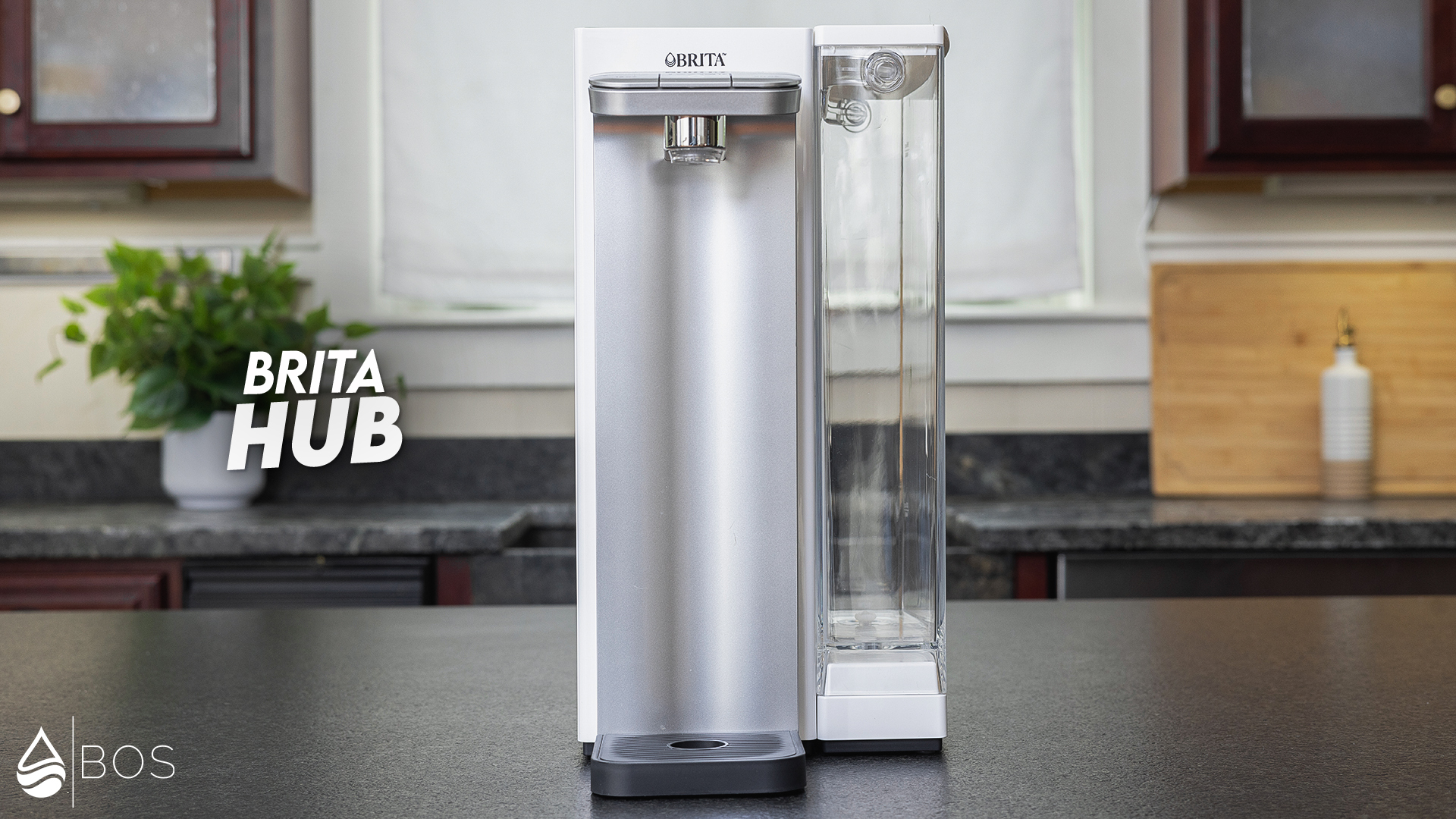
The Brita Hub produced adequate lab results and improved our water’s taste but left an off flavor. It also potentially leached aluminum into the water, but it has 73 NSF/ANSI-certified contaminants (mostly organics). Usability is average: setup and filter changes are easy (+ there’s an indicator light). Dispensing is splash-free, yielding 1 cup in a fast ~8.5 sec (suitable for most households) with 2 volume presets plus a custom option. Refilling can be a bit tricky: the tall, narrow feed tank seems prone to tipping and doesn’t sit snugly (the two tank install options seem rather unnecessary). More pros: fairly sturdy and BPA-free plastic build, water shortage light, 2-year warranty. More cons: a little noisy when dispensing and high upfront price. All considered, we think there are better countertop water filters.
The Brita Hub is an electric countertop water filter that doesn’t require a plumbing connection. It’s designed for use as a drinking water filter to purify municipal tap water.
As usual, we’ve tested the system with our own hands:
- Hands-on experience: We assembled, primed, used, and maintained it.
- Filtration effectiveness: We sent an unfiltered and a filtered tap water sample to a professional laboratory for analysis to determine real-world contaminant reduction. We also reviewed NSF/ANSI certifications and other available test data.
- More testing: We conducted taste and odor evaluations as well as filtration speed and maximum continuous dispensing tests.
- All other product aspects: We considered initial and long-term costs, warranties, additional features, frequent customer complaints, and more.

Final Rating: /5.00
FiltrationFiltration score combines our lab results and taste testing with NSF/ANSI certifications and 3rd-party contaminant reduction data.: /5.00
Usability: /5.00
CostsCost scores reflect overall value for money rather than price alone.: /5.00
| Type: | Electric Countertop Water Filter |
| PriceNo short-term sales. (Jul 13, 2026): | $194.95 |
| Yearly CostEstimate is based on rated/claimed filter life and 500 gallons annual water consumption. No short-term sales. (Jul 13, 2026): | ~$110 |
Final Rating: /5.00
What We Like Most
- Filtered water had a much better taste (but with a “filter aftertaste”) and no odor.
- High count of NSF/ANSI certifications for contaminant reduction but mostly limited to “easier-to-remove” organics.
- Fairly sturdy, BPA-free plastic build.
- Easy setup with clear, illustrated instruction booklet and YouTube tutorial video.
- Suited for daily use.
- Relatively fast, splash-free dispensing using responsive buttons.
- 2 volume presets + custom volume option.
- Can fill a 40-oz bottle with a single feed tank in one go.
- Feed tank is easy to remove/replace for refilling + water shortage indicator light.
- Easy filter changes – side panel access, quick eject/click in + filter change indicator.
- 2-year warranty.
What We Don’t Like
- Considerable amount of aluminum detected in filtered water in our lab testing (below strictest health guideline).
- Tall, narrow feed tank doesn’t sit securely in base + seems prone to tipping – rear placement may lessen risk.
- Slightly annoying noise when dispensing.
- Relatively heavy.
- High upfront cost.
- Customer complaints include leaking/dripping and units that stopped dispensing.
How the Brita Hub Compares to…
25 Other Countertop Water Filters
In this video, Sara explains why the Brita Hub did not become one of our top picks among the 26 countertop water filters we tested.
Please note: Our full guide on the best countertop water filters is available here.
Video Chapters + Comparison Sheet
- Link to Comparison Sheet
- 00:00 – Intro
- 00:33 – Our 26 Countertop Filters
- 03:14 – How We Tested & Rated
- 09:11 – Best Overall (AquaTru Classic)
- 14:33 – Best RO Budget Pick (AquaTru Carafe)
- 16:50 – Honorable Mention (Bluevua RO100ROPOT)
- 18:27 – Best “Regular” Filters (Aquasana CWM & ZeroWater)
- 27:47 – Best “Regular” Budget Pick (Waterdrop ED04)
- 33:04 – Summary
Full Analysis of the Brita Hub
Filtration: /5.00
The Brita Hub scored 3.55/5.00 for filtration. How? Most importantly, it achieved adequate results in our 2024 lab testing and produced odorless water that tasted better than our tap water overall but with a slight “filter aftertaste.” Plus, the system has a high count of NSF/ANSI-certified contaminants, though this is mostly limited to the easier-to-remove organics.
1. Lab Results: /5.00

Remember that our before vs after lab comparison is not an exact science. It’s informational and subject to variability, inaccuracies, and interferences caused by natural fluctuations in water quality, accidental contamination, human error, instrumentation issues, and more. Furthermore, our lab testing is limited to those contaminants present in our water supplies and at their respective concentrations, which is why the results may contradict third-party test data. As such, our lab testing can only give us a general idea for how effective a certain water treatment product might be.
In our lab test comparing an unfiltered and a filtered tap water sample, the Brita Hub could remove 9 undesirable impurities and contaminants to below the minimum detection level (so essentially to 100%): chlorine, bromodichloromethane, dibromochloromethane, chloroform, copper, barium, zinc, lithium, and nitrate.
The following substances remained in our water (note: in our view, most concentration increases are generally due to leaching, although natural fluctuations cannot be ruled out):
- Boron decreased by 60%.
- Strontium was reduced by 30%.
- Fluoride decreased by 5%. That said, our 2024 fluoride test method is known to be susceptible to alkalinity interference, with higher alkalinity producing artificially elevated fluoride readings. Because the filtered water showed increased alkalinity, this may have influenced our fluoride results.
- Uranium wasn’t reduced at all.
Aside from contaminant reduction, we found the following substances in our filtered water that were not present in the unfiltered water:
- Aluminum – At 0.14 ppm, it was 4.29x lower than the strictest aluminum health guideline we could find (0.6 ppm, California OEHHA), established to prevent neuro- and immunotoxic effects.
Lab Results Chart
| Potentially Harmful | Aesthetic Issues | Feed Water Level | Filtered Water Level | Reduction Rate | |
| Water Disinfectants | |||||
| Chlorine (mg/L) | ✖ | ✖ | 0.82 | 0 | 100% |
| Disinfection Byproducts | |||||
| Bromodichloromethane (µg/L) | ✖ | 0.61 | 0 | 100% | |
| Dibromochloromethane (µg/L) | ✖ | 0.55 | 0 | 100% | |
| Chloroform (µg/L) | ✖ | 0.55 | 0 | 100% | |
| Metals | |||||
| Copper (mg/L) | ✖ | ✖ | 0.06 | 0 | 100% |
| Barium (mg/L) | ✖ | 0.04 | 0 | 100% | |
| Boron (mg/L) | ✖ | 0.05 | 0.02 | 60% | |
| Zinc (mg/L) | ✖ | 0.01 | 0 | 100% | |
| Lithium (mg/L) | ✖ | 0.01 | 0 | 100% | |
| Strontium (mg/L) | ✖ | 0.44 | 0.31 | 30% | |
| Salts | |||||
| Nitrate (N) (mg/L) | ✖ | 1.42 | 0 | 100% | |
| Fluoride (mg/L) | ✖ | 0.4 | 0.38 | 5% | |
| Other | |||||
| Uranium (µg/L) | ✖ | 1 | 1 | 0% | |
| Other Parameters | |||||
| pH | 7.89 | 8.54 | |||
| Impurities NOT Detected in Unfiltered Tap Water Sample | |||||
| Aluminum (mg/L) | ✖ | ✖ | 0 | 0.14 | |
| Lab Reports: Filtered Water Report, Unfiltered Water Report | |||||
| Explanation: | |||||
| Full Removal | |||||
| Considerable Reduction | |||||
| Concentration More than Double of Unfiltered Water Sample | |||||
| Potential Leaching Reached or Exceeded the Strictest Public Health Guideline We Could Find | |||||
2. NSF/ANSI Certifications and Other Test Data
The Brita Hub is certified for the reduction of 73 contaminants by the WQA against NSF/ANSI standards 42, 53, and 401 and by the IAPMO against NSF/ANSI standard 53. However, this coverage primarily focuses on the easier-to-remove organics.
Reported reduction rates include:
- Chlorine (98.70%)
- Chloramine (96.70%)
- Particulate class I (99.90%)
- 50 VOCs (via chloroform surrogate testing – 95.00-99.00%+)
- Lead (99.80%)
- Mercury (96.40-96.50%+)
- Microplastics (0.5 to <1 μm – 99.90%)
- Several other emerging compounds, including pharmaceuticals and industrial chemicals (91.90-97.50%+)
Reduction rates are per the official performance data sheet.
3. Filtration Process
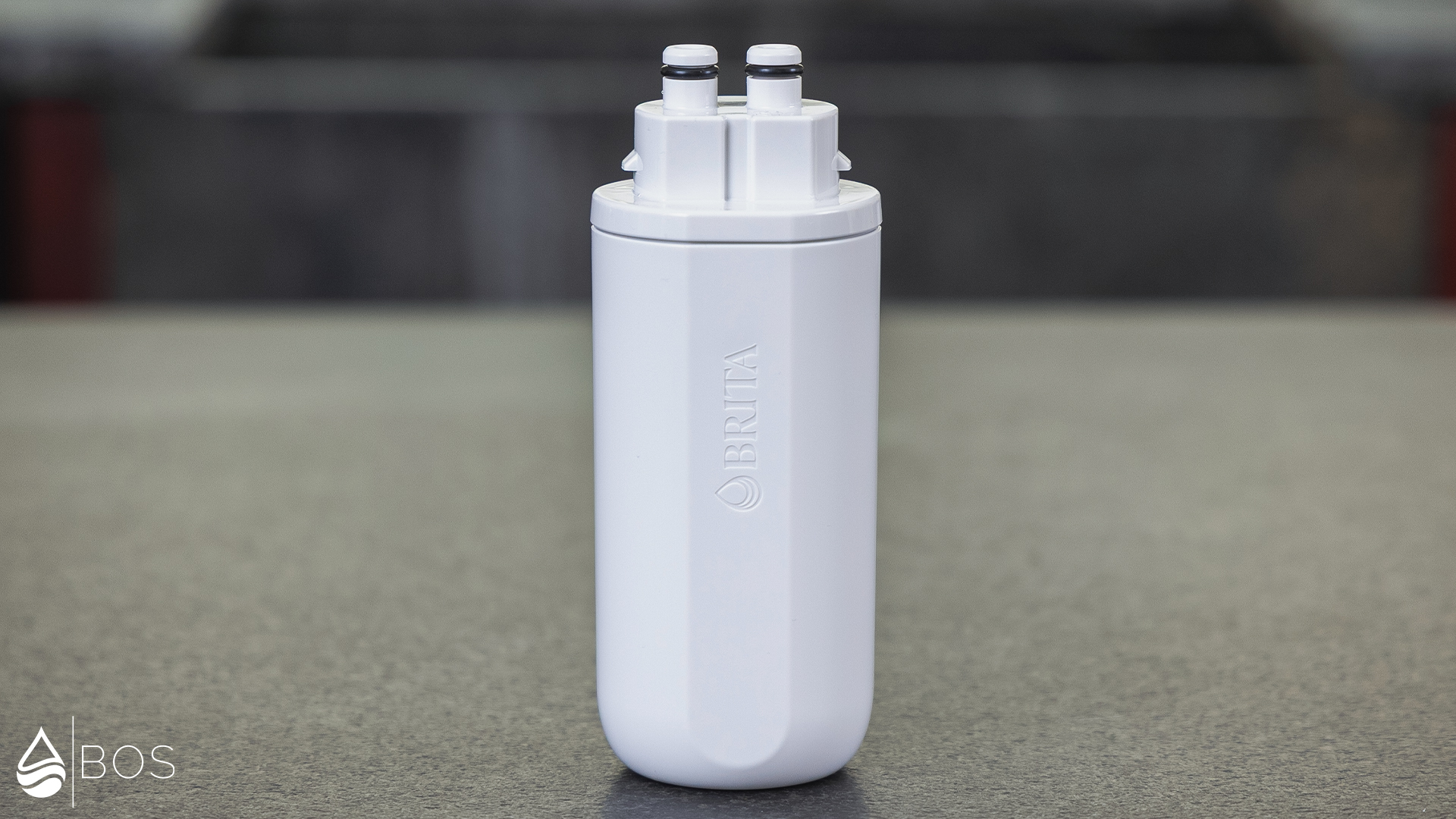
The Brita Hub filter is made from activated carbon block, which removes things like bad tastes and odors, chlorine/chloramine, disinfection byproducts and other organics, as well as certain metals. In addition, the block structure provides fine mechanical filtration due to its smaller pore size compared to granular carbon.
4. Taste and Odor Test
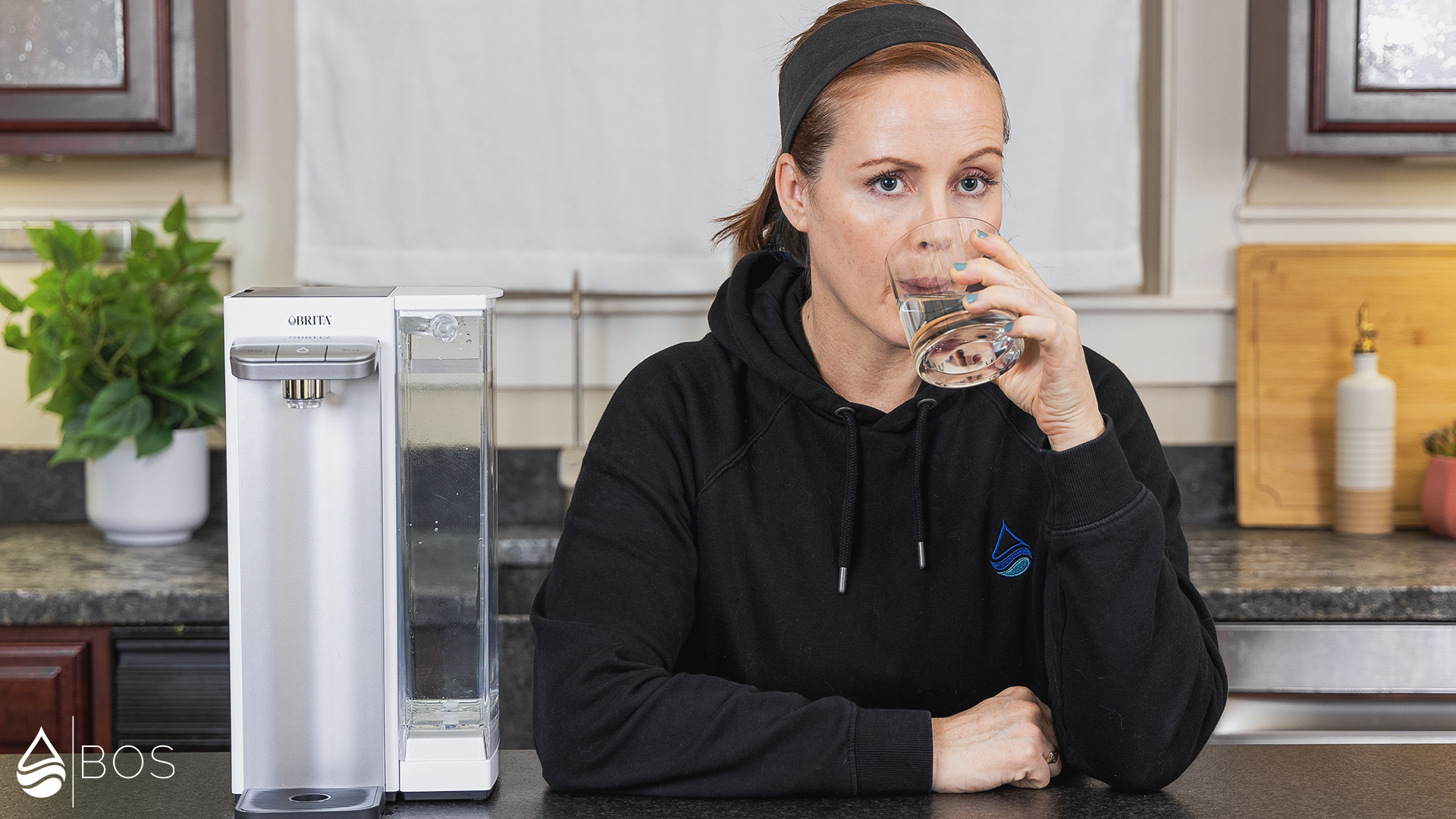
In our test, the filtered water was odorless, and the taste was improved overall compared to our tap water but had a slight “filter aftertaste.”
Usability: /5.00
The Brita Hub achieved a usability score of 3.85/5.00, based on its performance in the following categories:
- Initial system assembly including filter priming (1.00/1.00)
- Everyday use (2.25/3.40)
- Filter replacements (0.60/0.60)
1. Initial Setup & Filter Priming: /1.00
Assembling the Brita Hub is easy. In addition to clear, illustrated directions in the instruction booklet, there’s also a helpful tutorial video on YouTube.
Here’s a quick breakdown of the setup procedure:
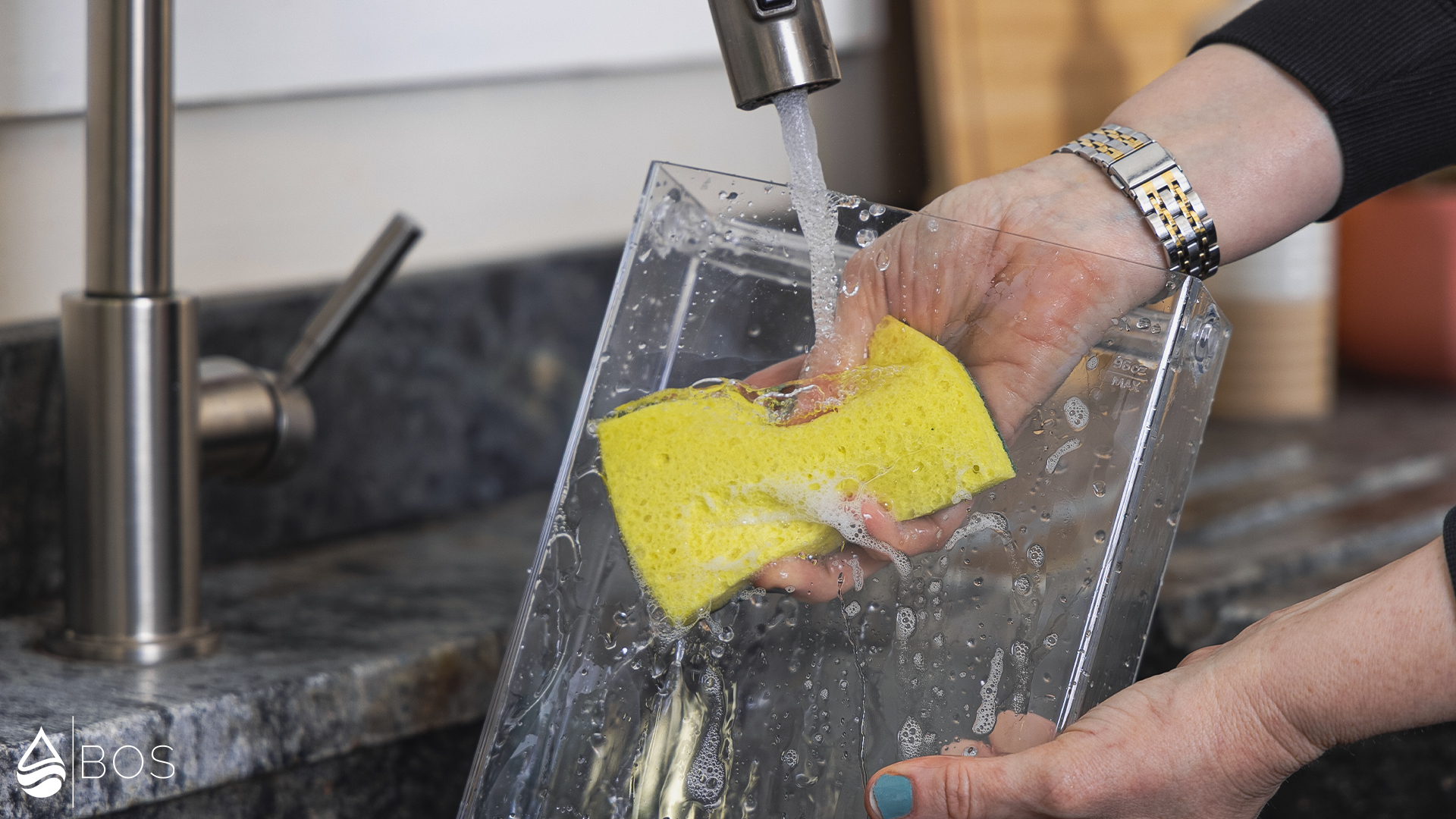
- Hand wash the water reservoir, lid, and drip tray in hot, soapy water; rinse and dry.
- Choose a reservoir configuration: default is side installation (outlined below), but it may also be installed at the back of the device using the provided spacer.
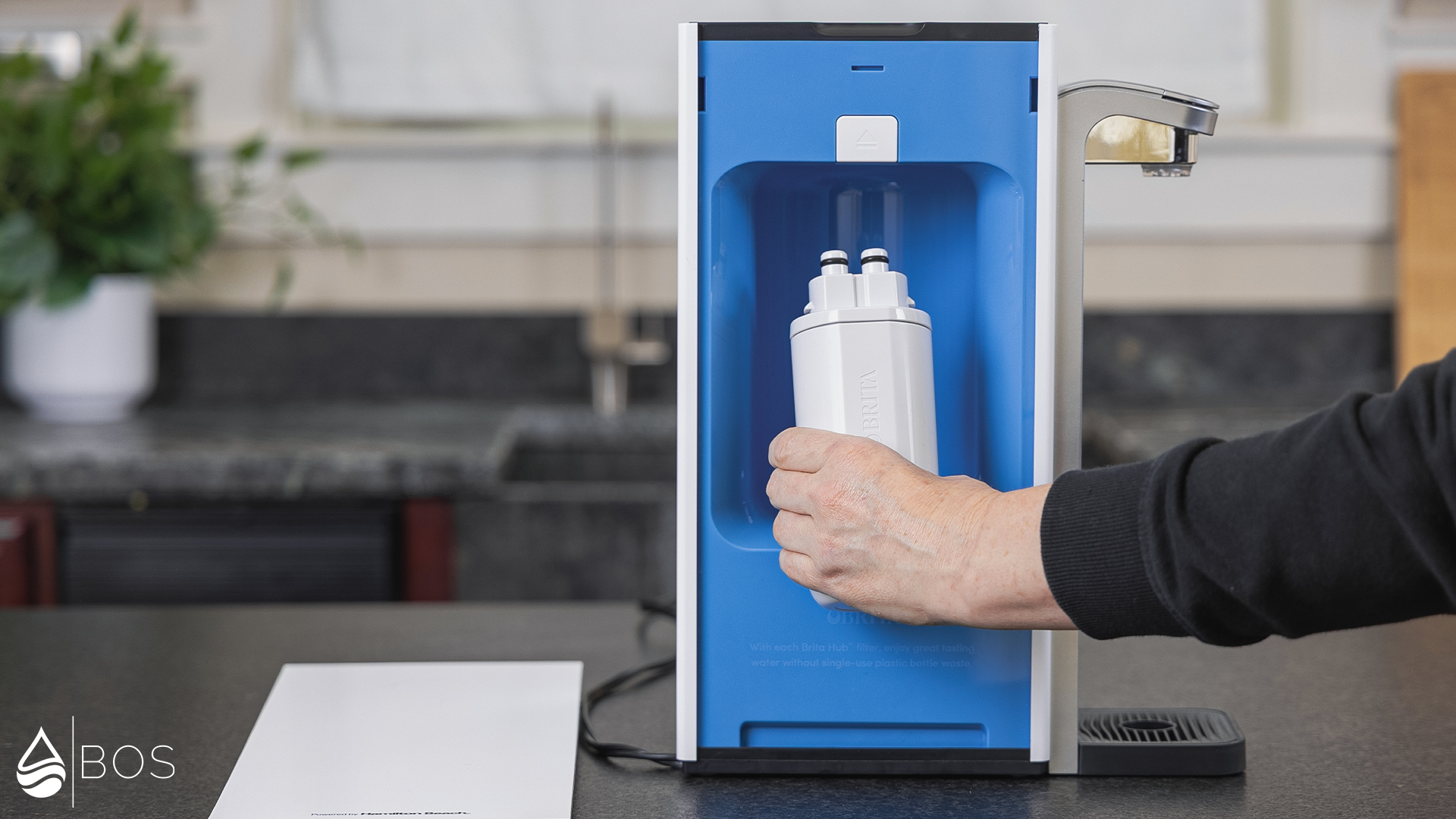
- Remove filter access panel by pulling panel out and lifting up.
- Insert filter with Brita logo facing you by inserting and pushing the top end into the filter holder until you hear 2 clicks.
- Reinstall panel, then remove lid from reservoir.
- Using the handle, lift the reservoir straight up to remove.
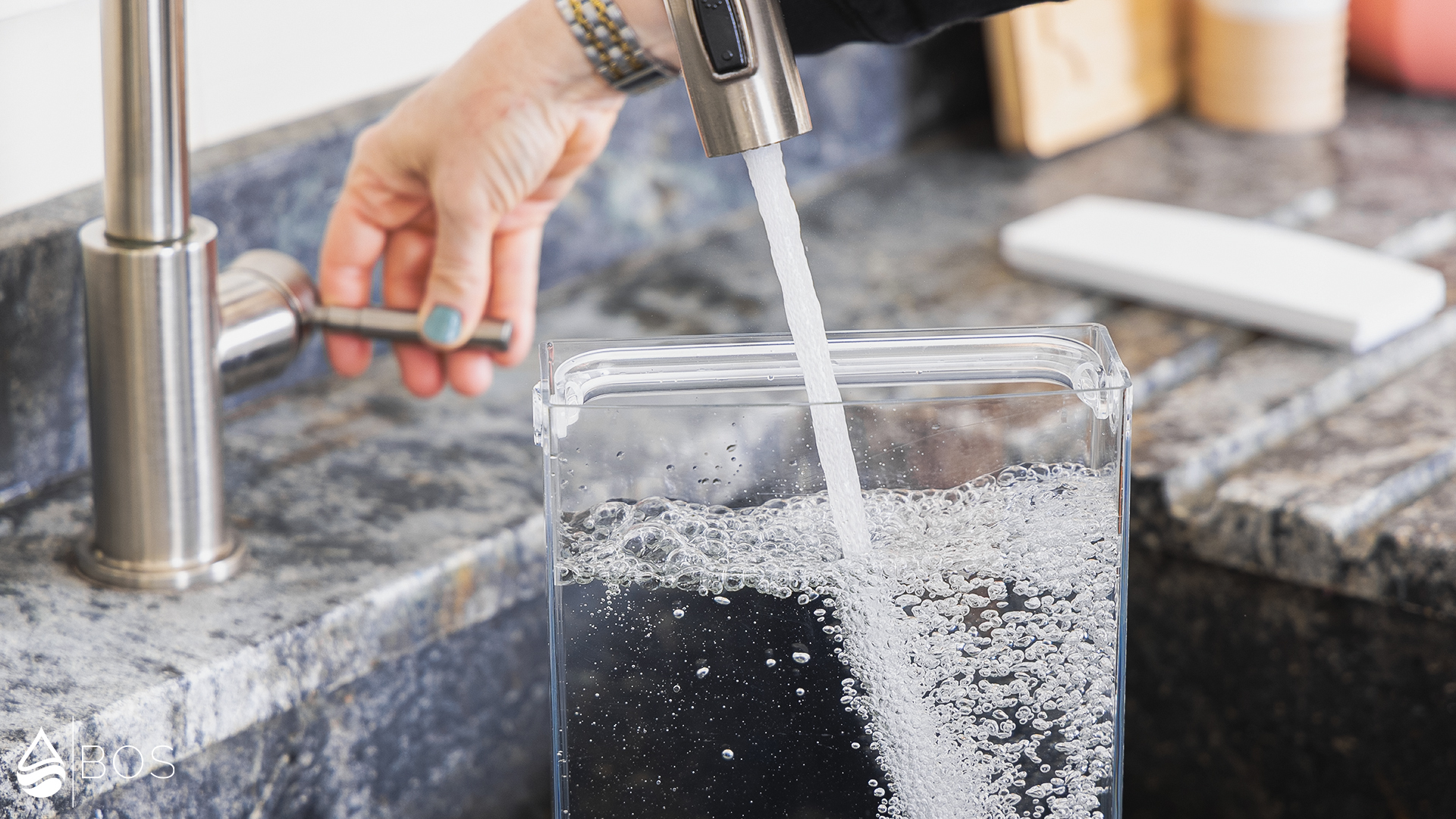
- Add cold water to MAX Fill line and reinstall reservoir on base. Replace the lid.
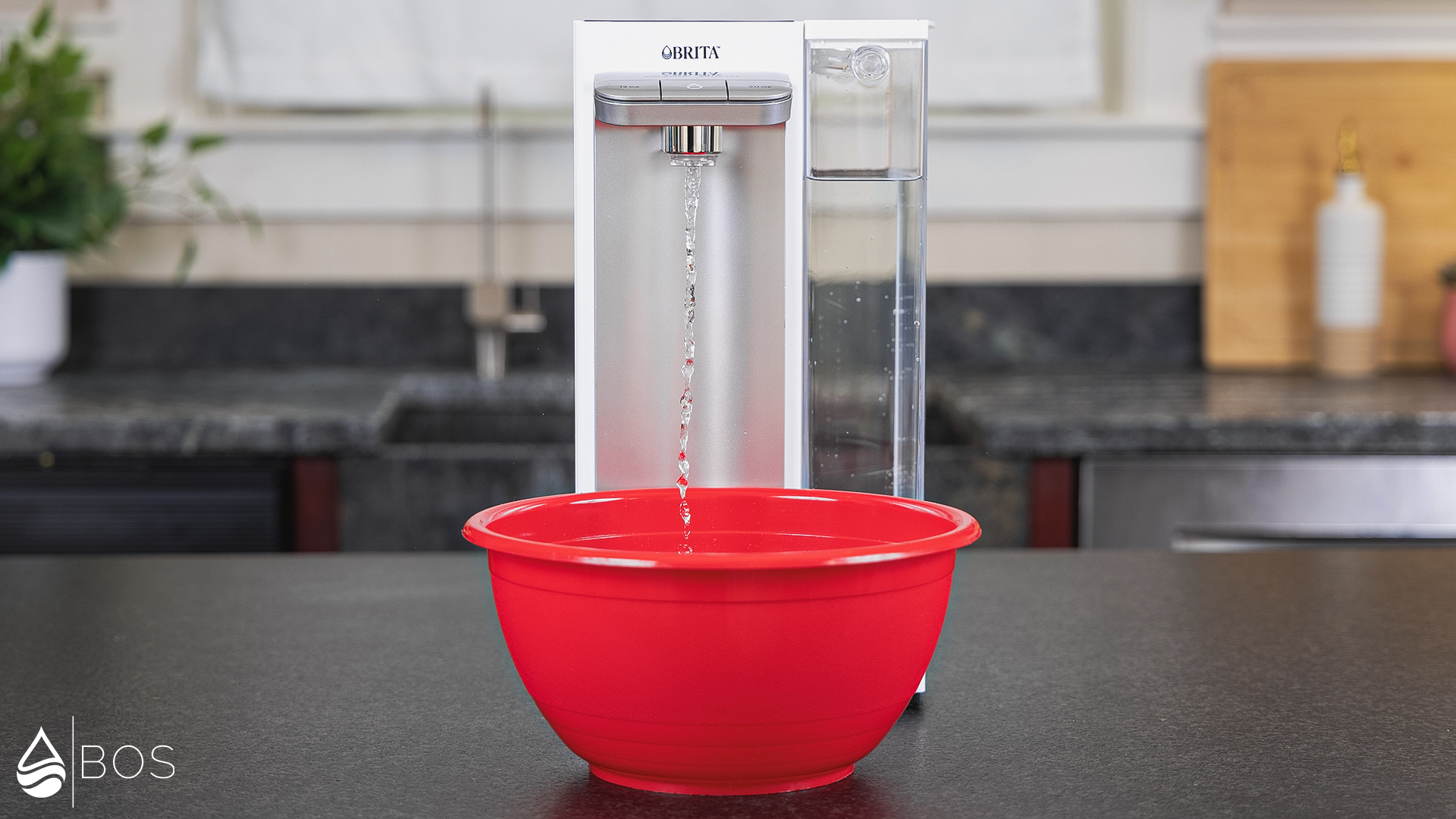
- Plug into outlet. Press and hold Manual Dispense button until reservoir is empty.
- Dispose of filtered water and refill reservoir to MAX Fill line. Repeat the flushing process a second time and discard the water.
- Now your system is ready to use.
2. Day-to-Day Use: /3.40
2.1 Speed & Water Capacity: /1.40
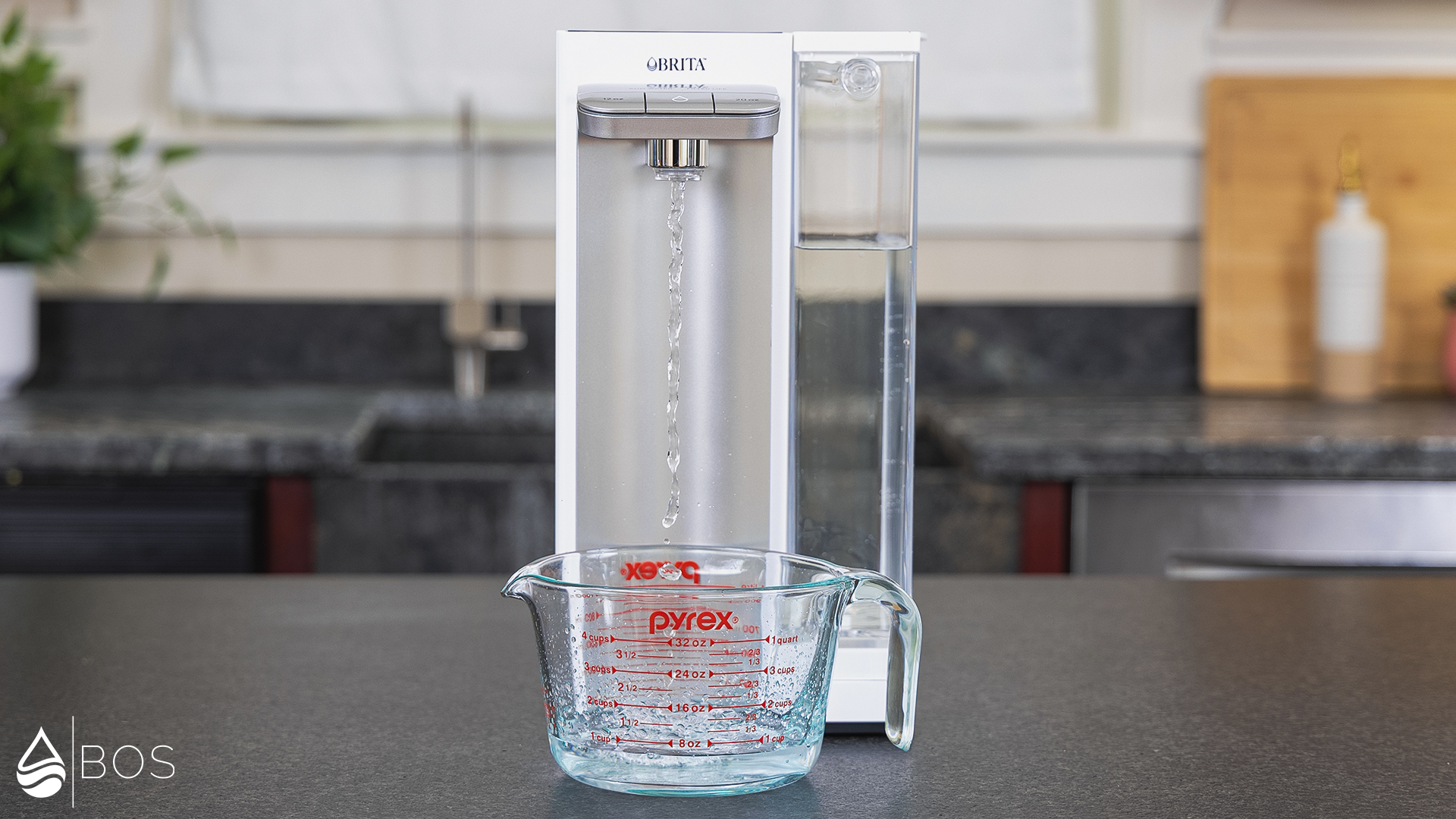
The Brita Hub is suited for daily use and offers fast dispensing speed for an “electric” type of countertop water filter. In our speed tests, it filtered and dispensed 1 cup in ~8.5 sec and 4 cups in ~32.75 sec when starting with a full feed tank. That means it filters fast enough to meet the daily water needs of the average-sized US households (~2.55-3.15 people), including 8-10 cup/hour thirst bursts.
The 12.25-cup feed tank allows you to easily fill a 40-oz bottle from a single refill and in one continuous pour. Plus, most standard 40-oz bottles should fit under the spout without tilting, as its height is 10.85″ from the base.
However, you can’t fit a standard 2-quart carafe under the spout, as it’s not high enough. Still, you could dispense 2 quarts without refilling the feed tank, assuming you found a container that would fit.
More specifically and based on a single full feed tank, the system dispensed ~98 oz in one sustained button press in our test before the tank was essentially empty and required refilling.
Assuming 25.5–31.5 cups of daily water consumption for the average US households, we estimate 3 daily refills when filling the feed tank to the max fill line – average for the electric countertop filters we tested.
The Brita Hub also features two volume presets, which ups the convenience factor and frees you to do other tasks instead of manning the pour.
2.2 Dispensing: /1.00
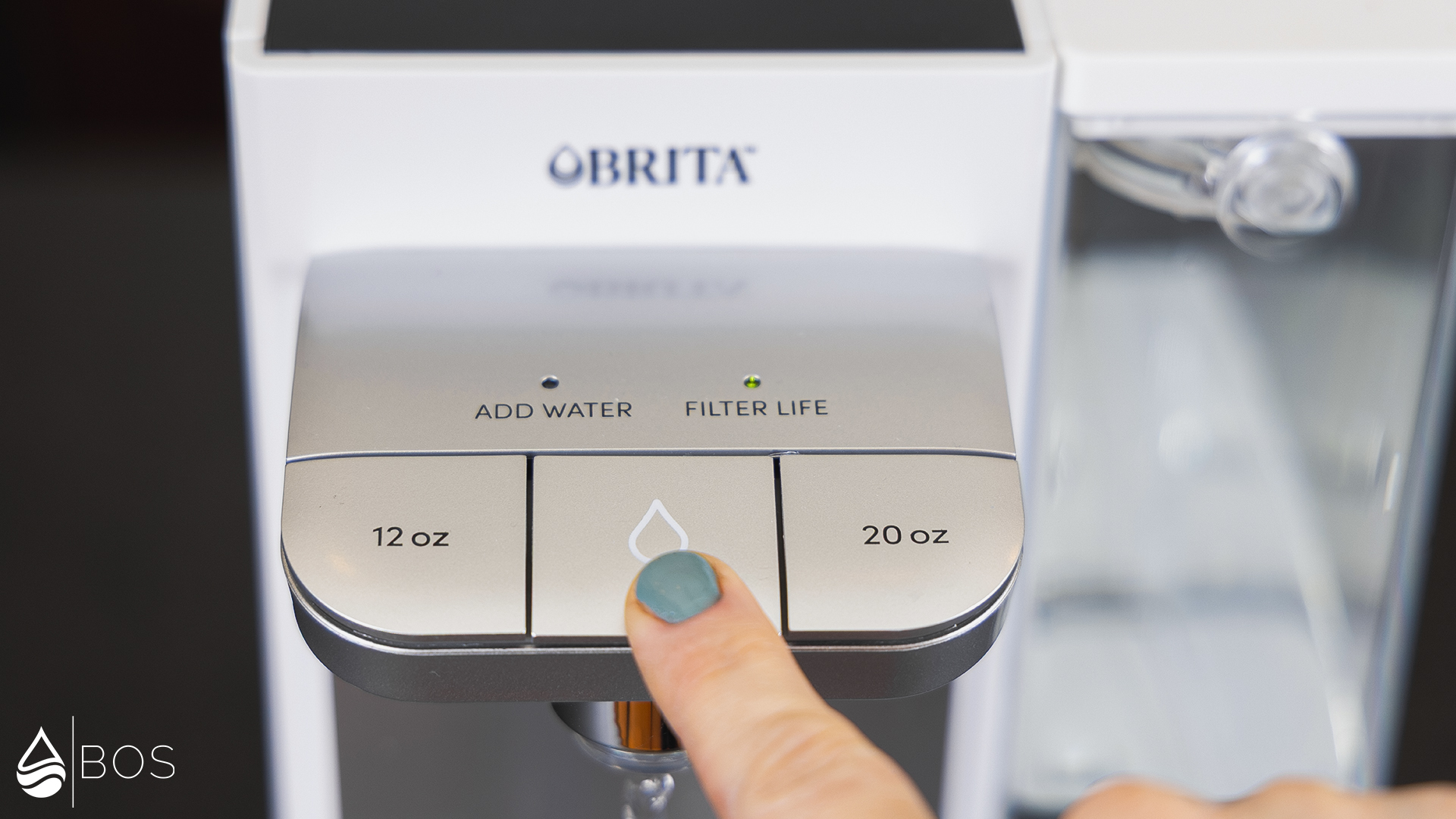
Dispensing water is easy and splash-free using the responsive buttons. The pour starts and stops crisply, with no lag or ramp down in our testing.
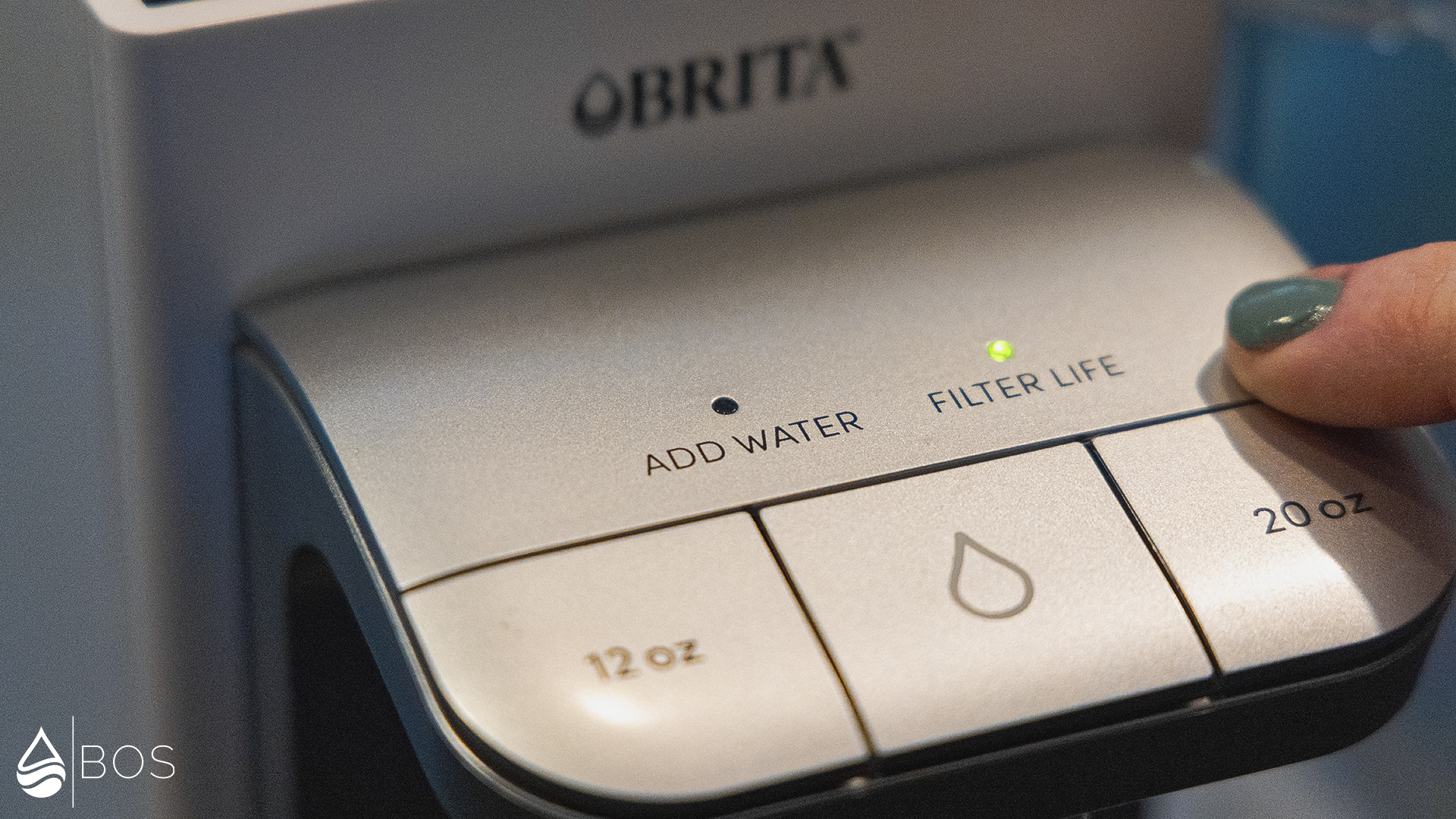
You may either press and hold the manual button to dispense a custom volume or utilize one of the two volume presets (12 or 20 oz) for a more hands-off approach.
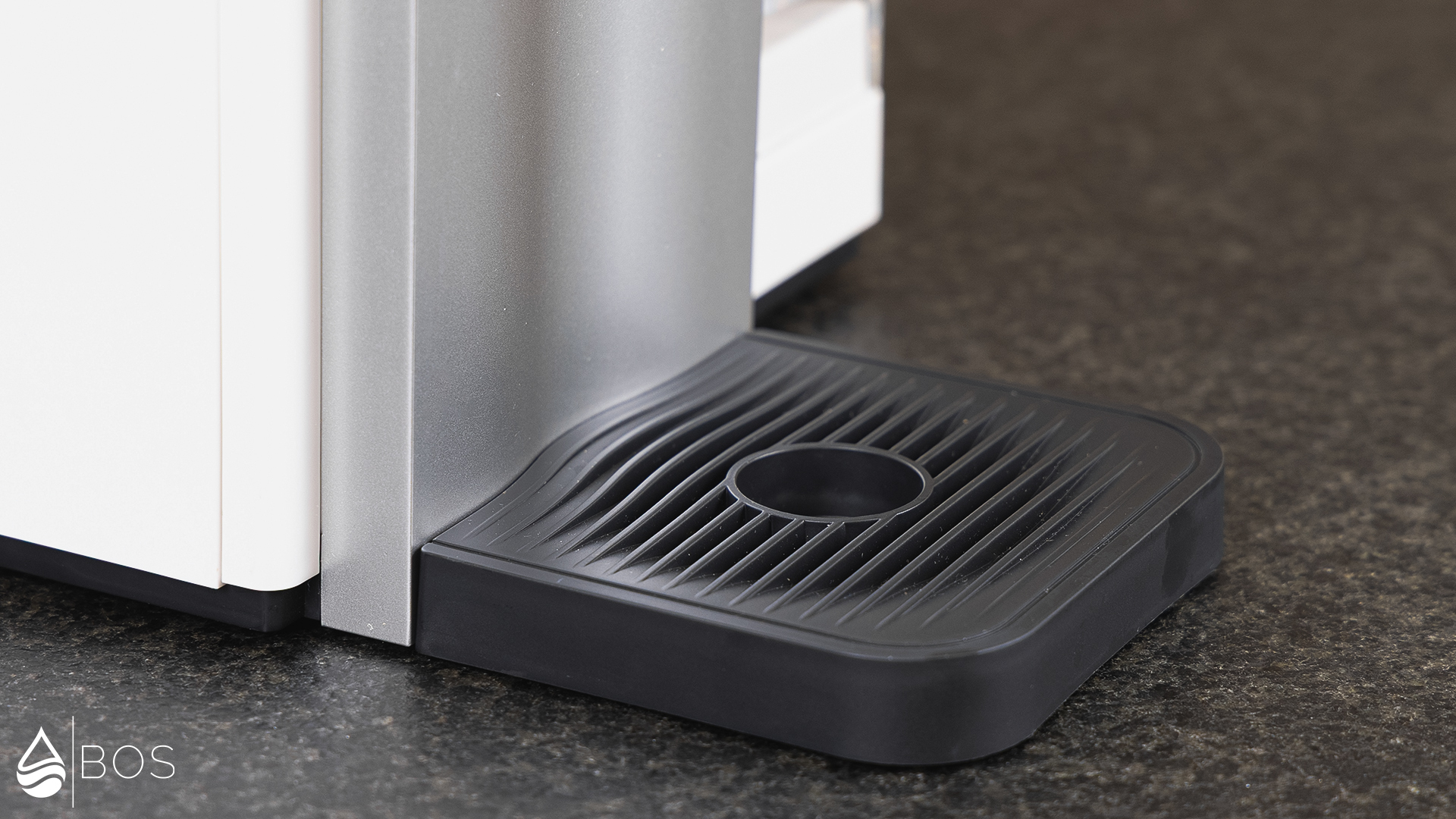
There’s even a drip tray with this system, though we found it wasn’t necessary, as there was no post-pour dripping to contend with.
2.3 Refilling & Size: /0.80
Refilling the Brita Hub is straightforward, as the feed water tank (reservoir) is easy to remove and place back on its base. However, it’s also tall and narrow, which takes some acclimation – we felt that it would be easy to tip over while filling if you aren’t careful.
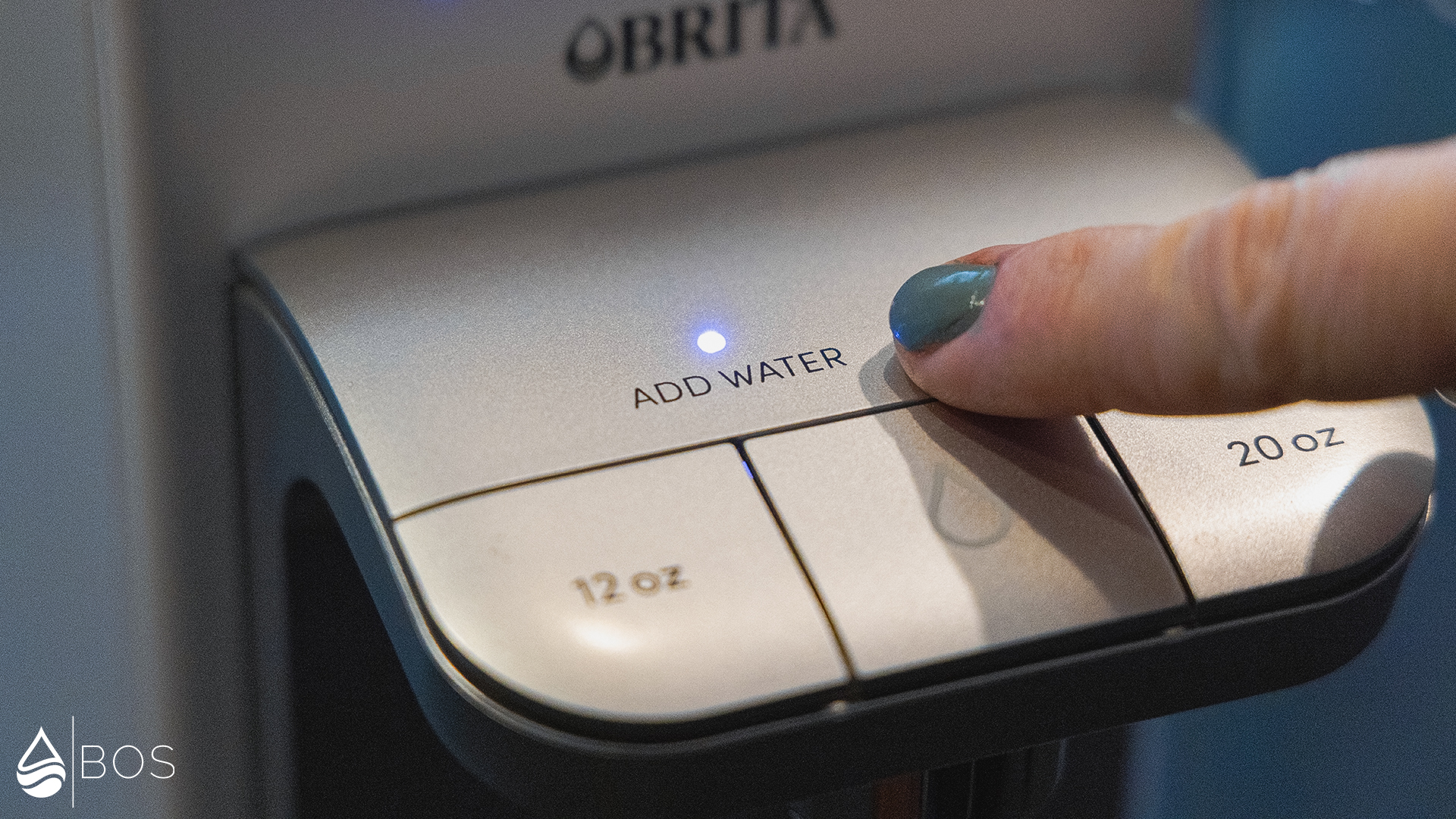
There’s a max fill line on the tank, and a water shortage indicator light lets you know when it’s time to refill (though it’s also easy to view the water level through the transparent plastic).
Measuring 7.8″x14.4″x11″ (WxHxD) or 7.2″x14.4″x13.75″ (WxHxD) with the feed tank positioned on the side versus in the back, respectively, the Brita Hub fits under most kitchen cabinets (18″ clearance). At 7.9 lbs with a wet filter installed, it is relatively heavy for the electric-type countertop systems we tested. On the other hand, its footprint is about average for the tested systems, occupying ~99.00 in2 (~0.69 ft2). But at more than 7″ wide in either configuration, it is not streamlined enough to fit in narrow spots.
2.4 Other: /0.20
A couple other factors impact the Brita Hub’s overall usability:
- Customizable reservoir placement allows you to choose between installing the feed tank on the side or in the back of the unit to “optimize space on your counter.” While both configurations work just fine, rear placement increases the overall depth and only shaves ~0.6″ off the width – not really a space-saving improvement.
- Its tall, narrow feed tank doesn’t sit very securely on the base and seems prone to getting knocked over if bumped. This is especially true if you choose the side reservoir placement rather than the back, where the tank is relatively protected.
- It makes a slightly annoying noise when dispensing, though we didn’t find it to be overly vexing.
3. Filter Replacements: /0.60
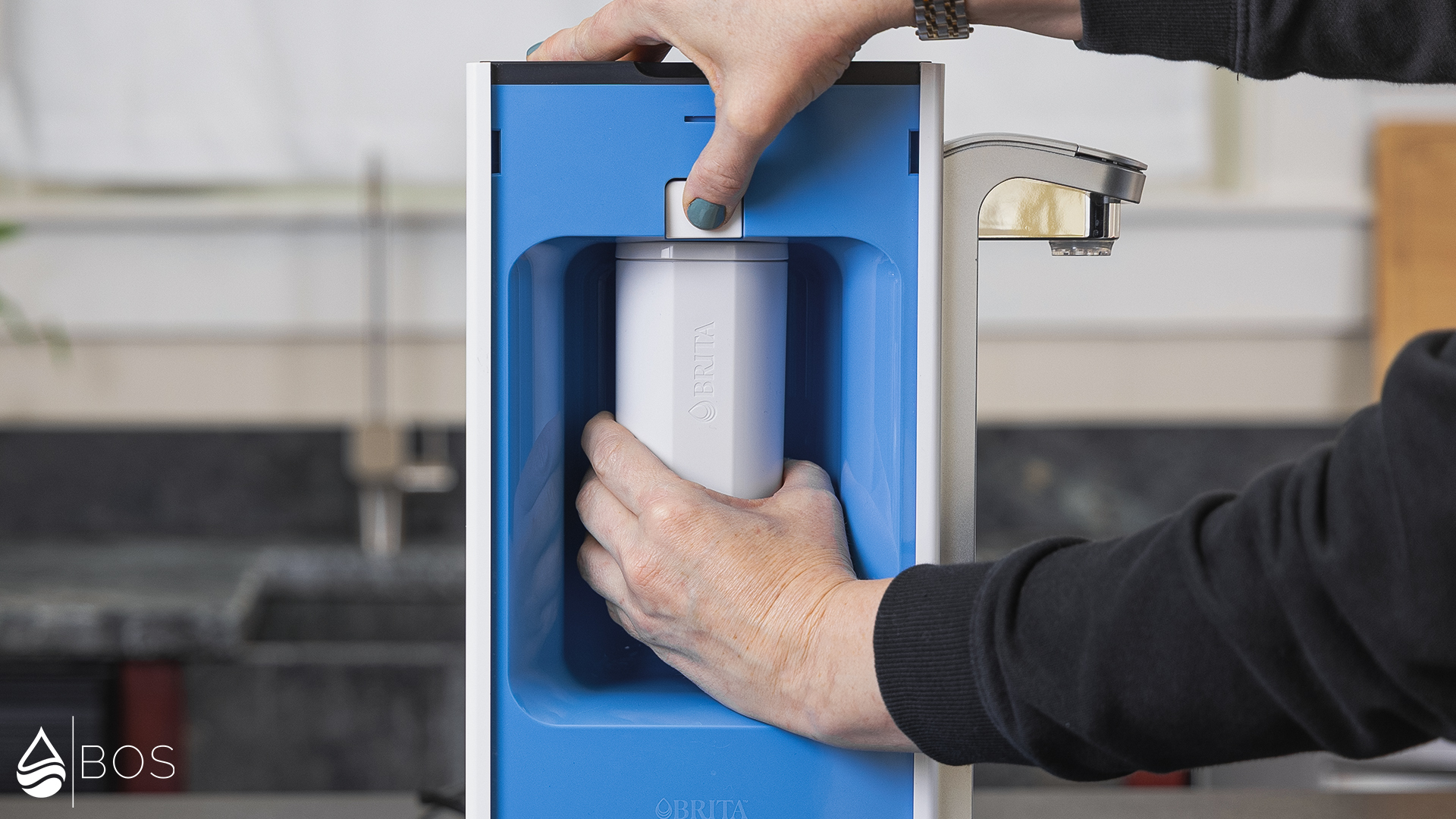
Filter replacements are very simple: the filter is easily accessible through the side panel, ejects with a push of a button, and quickly clicks in to install. The filter change indicator light lets you know when it is time to change it.
Rated filter life is 120 gal or 6 months.
Assuming 500 gallons of yearly water consumption for the average household, we estimate that you will have to change the filter 4-5x annually.
Support BOS Water’s Mission!
Every coffee helps us test more products and bring you unbiased results!
Costs: /5.00
Based on value for money, the Brita Hub achieved a cost score of 4.13 out of 5.00, indicating it is priced below average for what it offers compared to competing systems (a score of 4.00 represents average value). Notably, its upfront price is well above average, but its annual filter replacement costs are about average compared to the other countertop water filters we tested.
1. Upfront Price
As of Jul 13, 2026, the Brita Hub is priced at $194.95, which is well above the $150 average we estimate for this type of water filter.
2. Long-Term Expenses for Filter Replacements
Based on 500 gallons consumption and a 120-gal or 6-month filter life for the filter cartridge, we estimate $110 in annual filter replacement costs, which is around the $120.11 average across all the tested countertop water filters.
3. Product Warranty
The Brita Hub comes with a long 2-year warranty.
4. Other Cost Factors
The water shortage indicator light lets you know when it’s time to refill.
Additional
1. Construction
The BPA-free plastic construction feels solid overall, although the unit feels slightly less sturdy than similar systems. For instance, we could envision the drip tray connector piece breaking over time if removed often. On the other hand, the rubber-gripped bottom is a nice touch, as it keeps the unit from sliding around on your countertop.
2. Frequent Customer Complaints
We read about issues with leaking/dripping and units that stopped dispensing.
We did not encounter these problems firsthand.
Bottom Line: Fairly Adequate across the Board (/5.00)
Filtration weighted at 60%, and usability and cost at 20% each, the Brita Hub scored a final rating of 3.73 out of 5.00.
Filtration performance was adequate. While the system completely removed 9 contaminants in our lab test, it showed evidence of potential aluminum leaching, though still below the strictest health guideline. The filtered water was odorless and tasted better than our tap water yet had a bit of a “filter aftertaste.” On the plus side, the system has a high number of NSF/ANSI-certified contaminants (73), though coverage focuses on the easier-to-remove organics and overlooks some important impurities, including most heavy metals.
Usability is also average: it’s very easy to set up, and filter changes are extremely simple with a helpful indicator light to remind you.
It dispenses water pretty quickly and without splashing. Two volume presets add convenience, or you can select a custom volume by pressing and holding the dispense button. The flow starts and stops cleanly, with no post-pour dripping (though a drip tray is provided). It’s a little noisy while in use, but not prohibitively so.
Refilling, on the other hand, is more challenging. The tall, narrow feed tank is easy to remove and replace, but it doesn’t sit very securely on the base and seems prone to tipping if bumped accidentally. You can choose to install the tank on the side versus in the back of the unit to best suit your space; the latter configuration may reduce the risk of toppling, but only shaves ~0.6″ off the width and increases the overall depth.
The ~12.25-cup feed tank requires an average number of daily refills, with the water shortage indicator light alerting you to top up.
Build quality is solid overall, though the BPA-free plastic construction seems a bit less sturdy compared to similar systems. Still, the long two-year warranty provides some peace of mind regarding longevity.
While upfront price is well above average, ongoing filter replacement costs are around average.
With just so-so performance all around, the Brita Hub isn’t our first choice for a countertop water filter.
About the Author(s)

Sara has been a lifelong home-improvement fan (she’s been hooked on This Old House since she was five) and taught herself any project she didn’t already know by watching YouTube tutorials. She is also an award-winning filmmaker. Armed with this skillset, Sara installs, primes, samples, uses, and maintains nearly every point-of-use water treatment system we test – then brings her results to life on camera for our YouTube channel.

Raoul has a background in mechanical engineering and has been writing about home water treatment since 2015. He designs our product review processes, analyzes the results, and ties everything together. As editor-in-chief, he tries hard to keep the whole operation running smoothly behind the scenes.